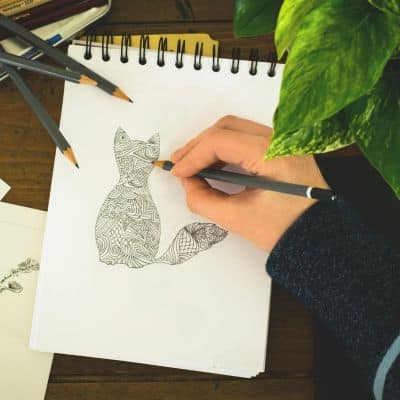
Have you ever picked up a pencil while waiting for something and started drawing without really thinking about it?
Maybe it began with a few circles. Then a leaf. Then some random lines around the edge of the page. Before you knew it, half the notebook was covered in tiny sketches.
That is the charm of a pencil doodle.
You do not need expensive art supplies, perfect handwriting, or years of drawing practice. A regular pencil and a piece of paper are enough to turn an empty corner into something surprisingly interesting.
Pencil doodles can be soft and simple, heavily shaded, funny, realistic, abstract, or completely random. You can use them to decorate notes, relax after a long day, practise drawing, or simply keep your hands busy.
If you are new to doodling, it also helps to understand what a doodle is before worrying about whether your drawings look “good.”
This guide breaks pencil doodling into four parts: simple ideas, basic techniques, creative subjects, and ways to make your doodles more personal and expressive.
What Is a Pencil Doodle?
A pencil doodle is a small, informal drawing created with a pencil, usually without a detailed plan.
Unlike a finished illustration, a doodle does not have to tell a complete story or look perfectly polished. It can be a collection of lines, shapes, symbols, patterns, objects, faces, plants, animals, or whatever happens to come to mind.
That freedom is what makes doodling so enjoyable.
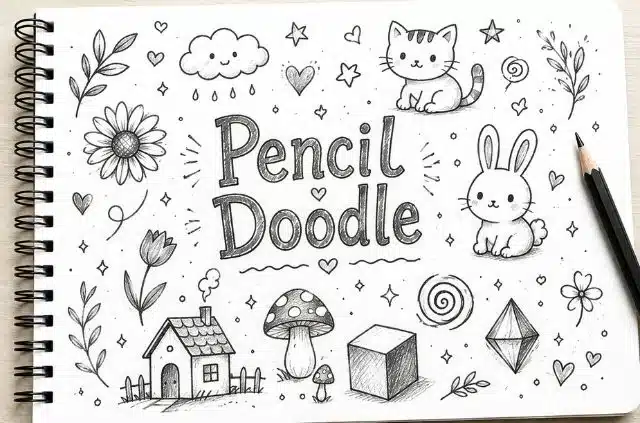
You can draw a tiny flower beside a shopping list, cover an entire notebook page with geometric patterns, or spend ten minutes shading a little 3D cube.
There is no single correct way to doodle.
If you already enjoy drawing in the margins of notebooks, you are probably doodling more than you realise. And if you are wondering why people doodle, there is more to the habit than simply making random marks on paper.
Why Use a Pencil for Doodling?
A pencil is one of the easiest tools for beginners because it is forgiving.
You can:
- Make very light lines.
- Press harder for darker marks.
- Build shadows gradually.
- Erase mistakes.
- Blend different shades.
- Create both delicate and bold drawings.
- Experiment without wasting materials.
You can also create surprisingly detailed artwork using nothing more than an ordinary graphite pencil.
The best part? You do not have to sharpen your artistic skills before you start. The doodling itself becomes practice.
Easy Pencil Doodle Ideas for Beginners
If you are staring at a blank page and thinking, “What am I supposed to draw?”, start small.
The following pencil doodle ideas are simple enough for beginners but can also become more detailed as your confidence grows.
1. Pencil Doodle Flowers
Flowers are one of the easiest places to start.
Draw a small circle in the middle and surround it with simple petals. Try different shapes: rounded petals, pointed petals, tiny overlapping petals, or messy hand-drawn ones.
Then add a stem and a few leaves.
Once you understand the basic shape, experiment with different flower arrangements. You can also explore more structured easy flower doodles when you want to fill a larger page.
2. Tiny Leaf Doodle Idea
Leaves are incredibly useful for filling empty spaces.
Try drawing:
- Single leaves
- Curved leaves
- Long narrow leaves
- Heart-shaped leaves
- Tiny branches
- Leaf clusters
- Hanging vines
You can keep them as simple outlines or add a central vein with a few small lines.
For a fuller botanical page, plant doodles offer plenty of inspiration for turning simple leaves into decorative drawings.
3. Little Hearts
A heart takes only a few seconds to draw, but you can change its personality completely with shading and patterns.
Try a plain outline, a shaded heart, a striped heart, a cracked heart, a heart surrounded by tiny stars, or several overlapping hearts.
You can even turn the heart into a 3D-looking object by adding a darker edge on one side.
4. Stars and Sparkles
Stars are perfect for filling tiny gaps between larger doodles.
Draw simple four-point stars, five-point stars, shooting stars, or tiny sparkle symbols.
Do not worry about making every point identical. Slightly uneven stars can actually make the page feel more hand-drawn.
5. Clouds
Clouds work beautifully with pencil because you can use light shading underneath them.
Start with a few rounded curves. Add a slightly darker underside and leave the upper section almost white.
A few clouds scattered across a page can also make other doodles feel like part of the same scene.
6. Cute Cat Faces
You do not need to draw an entire cat.
A simple circle or oval with two ears, two eyes, a tiny nose, and whiskers can become an adorable cat doodle.
Change the ears, expressions, or eye shapes to create different personalities.
If you enjoy animal doodles, a collection of cat doodle ideas can help you explore different ways of simplifying animal shapes.
7. Bunny Faces
Bunnies are another beginner-friendly subject.
The easiest version is simply a round face with two long ears. From there, you can add whiskers, sleepy eyes, little teeth, or different expressions.
You can also turn the basic bunny into a complete character with a tiny body and oversized ears.
8. Simple Houses
Draw a square, add a triangular roof, then experiment.
You could create:
- A tiny cottage
- A crooked house
- A house surrounded by flowers
- A miniature treehouse
- A cosy winter house
- A strange fantasy house
Do not try to make the perspective perfect. Doodles often look more charming when they have a little personality.
9. Mushrooms
Mushrooms are fun because their shapes are naturally decorative.
Try a rounded cap with spots, a tall narrow mushroom, a cluster of tiny mushrooms, or a fantasy mushroom with patterns.
Use darker pencil strokes underneath the cap to create depth.
10. Pencil Doodle Eyes
Eyes are surprisingly addictive to draw.
Start with a simple almond shape. Add an iris, pupil, eyelashes, and a little shading.
Once you become comfortable, experiment with different expressions.
One eye can look sleepy while another looks surprised. That slight difference can make a page feel playful instead of repetitive.
11. Stars, Moons and Planets
A crescent moon surrounded by tiny stars is a classic doodle combination.
You can add craters, rings, dots, clouds, or little constellations.
Keep the pencil pressure light for the background and use darker marks on the main shapes.
12. Simple Food Doodles
Food is another easy subject because many foods have recognisable shapes.
Try:
- Cups
- Doughnuts
- Ice cream
- Pizza slices
- Strawberries
- Cupcakes
- Apples
- Coffee mugs
- Cookies
- Watermelons
Give them tiny faces if you want them to look playful.
For completely silly pages, even deliberately strange drawings can work. That is where silly doodles can become useful inspiration.
Pencil Doodle Techniques That Make Simple Drawings Look Better
The difference between a flat-looking pencil doodle and one that seems to have depth often comes down to a few basic techniques.
You do not need to master all of them at once.
Start with one.
1. Change Your Pencil Pressure
This is probably the most useful pencil doodling technique.
Press lightly when you want a soft or faint line.
Press harder when you want a darker line.
For example, imagine drawing a leaf. Keep the outer edge fairly dark, use a lighter line for the veins, and shade one side of the leaf more heavily.
Suddenly, that simple shape has dimension.
2. Use Hatching
Hatching means creating shading with repeated lines.
Draw several parallel lines close together.
The closer the lines are, the darker the area appears.
You can use straight, curved, vertical, horizontal, or diagonal lines depending on the object.
3. Try Cross-Hatching
Cross-hatching takes hatching one step further.
Draw one group of lines in one direction, then add another group crossing over them.
The result creates a darker, textured area.
It works especially well for:
- Shadows
- Clothing
- Hair
- Buildings
- Objects with rough surfaces
- Abstract patterns
4. Blend Carefully
Graphite can be blended to create soft shadows.
You can use a blending stump, tissue, or even your finger, although keeping your drawing clean is easier with a proper blending tool.
Do not blend everything.
If every part of a doodle is soft and smudged, you can lose the crispness of the drawing. Leaving some lines sharp creates contrast.
5. Add a Cast Shadow
Want a simple object to look like it is sitting on the page?
Add a shadow underneath it.
For example, draw a small cube and place a soft dark shape underneath one side.
The shadow gives the viewer a clue about where the object is positioned.
6. Create 3D Doodles
Three-dimensional pencil doodles are especially satisfying because they can look complicated while being built from simple shapes.
Start with:
- Cubes
- Cylinders
- Spheres
- Stairs
- Tunnels
- Impossible shapes
For more optical and dimensional ideas, illusion doodle art explores ways that lines, perspective, repetition, and shading can make a flat drawing appear much deeper.
7. Use Repetition
Repetition makes even a simple doodle look intentional.
Take one basic shape and repeat it.
For example:
○ ○ ○ ○ ○
Then change the size.
○ ◯ ● ◉
Or create repeated waves, leaves, stars, circles, or squares.
Patterns can quickly turn an empty notebook margin into something interesting.
8. Leave Some White Space
This sounds strange when you are trying to fill a page, but empty space matters.
If every section is packed with dark lines, the drawing can become difficult to look at.
Leave a little breathing room between your doodles.
Sometimes one tiny flower surrounded by blank paper looks better than twenty flowers squeezed together.
9. Combine Lines and Shading
A common beginner mistake is relying entirely on outlines.
Try combining the two.
Use lines to define the object and shading to suggest its volume.
A simple circle, for example, becomes much more interesting when one side is darker and the opposite side remains light.
Creative Pencil Doodle Ideas to Take Your Drawing Further
Once you are comfortable with basic shapes and shading, you can stop thinking of doodling as a collection of tiny drawings and start treating the entire page as one piece of artwork.
This is where things get really fun.
20 Pencil Doodle Ideas to Try
1. Pencil Doodle Border
Create a border around a notebook page using leaves, stars, flowers, waves, or geometric shapes.
2. Botanical Corner
Draw vines growing from one corner of the page and slowly spreading across the edge.
3. Doodle Garden
Combine flowers, leaves, mushrooms, insects, and tiny plants into one miniature garden.
4. Animal Pattern
Draw several tiny animal faces and repeat them across the page.
5. Pencil Doodle Mandala
Start with a small centre shape and gradually build symmetrical patterns around it.
If you like intricate repeated patterns, Zen doodle patterns can help you understand how simple marks can become much more detailed designs.
6. Doodle Clouds
Create a sky scene with clouds, moons, stars, birds, and tiny planets.
7. Tiny House Scene
Draw several little houses surrounded by trees, flowers, paths, and fences.
8. Pencil Doodle Face
Draw a simple face and fill the hair with flowers, leaves, stars, or abstract patterns.
9. Patterned Heart
Draw a large heart and divide it into sections. Fill each section with a different pattern.
10. Pencil Doodle Snake
Create a curved snake and decorate its body with geometric shapes.
11. Doodle Frame
Draw a decorative frame around a blank centre. The middle can later hold a quote, name, date, or small drawing.
12. Ocean Doodle
Combine waves, shells, fish, bubbles, coral, and tiny sea creatures.
13. Summer Doodle Page
Think sunglasses, ice cream, sunshine, beach umbrellas, fruit, flowers, and little waves. Seasonal subjects work particularly well when you want a page that feels spontaneous; summer doodle ideas can be built around the same approach.
14. Pencil Doodle Maze
Draw a maze using curved and straight lines, then decorate the empty spaces with small symbols.
15. Geometric Doodle
Combine triangles, squares, circles, lines, and repeating patterns.
16. Impossible Shapes
Draw shapes that appear to bend, overlap, or connect in impossible ways.
17. Pencil Doodle Lettering
Write your name or a short word and decorate the letters with flowers, dots, stars, leaves, or tiny patterns.
18. Story Doodle
Instead of drawing unrelated objects, make several small drawings that connect.
For example:
tiny house → path → tree → bicycle → park → picnic
Suddenly, the doodles tell a little story.
19. Doodle Notes
Pencil doodles do not have to live separately from your writing. Small icons, arrows, boxes, flowers, and symbols can make handwritten notes easier to scan and more visually memorable. This approach fits naturally with doodle notes.
20. Completely Random Page
And sometimes the best idea is no idea at all.
Put your pencil on the page and start drawing.
A line becomes a leaf. The leaf becomes a branch. The branch becomes a tree. Suddenly, you have no idea what you are drawing — and that is exactly the point.
How to Make Pencil Doodles Look More Interesting
You do not need complicated techniques to make a doodle stand out.
Try these small changes.
Mix large and tiny shapes
A large flower beside several tiny stars creates visual variety.
Mix dark and light areas
Dark pencil marks naturally draw attention, while lighter marks keep the page from feeling heavy.
Change the direction of your lines
If everything points in the same direction, the drawing can feel repetitive.
Add texture
Use dots, short lines, cross-hatching, waves, spirals, or small repeated marks.
Let some drawings overlap
Overlapping objects can make a page feel fuller and more connected.
Give objects personalities
A tiny coffee cup with sleepy eyes suddenly feels like a character.
A grumpy-looking flower is even better.
You can find additional cool doodle ideas for combining simple subjects into more imaginative drawings.
Pencil Doodles for Notes, School and Everyday Pages
One of the easiest ways to practise is to doodle while doing something you already do.
For example, add a tiny pencil beside a heading, a star next to an important point, or a little flower in an empty corner.
Students can use small drawings to decorate notebooks and make headings more visually distinct. Even simple doodles can make otherwise boring pages feel more personal.
If you are looking for quick drawings that can be made during spare moments, easy doodles to draw when bored in class can inspire small, low-pressure sketches.
The key is not to turn every page into artwork.
Sometimes one tiny drawing is enough.
Pencil Doodles for Mindful Drawing
Doodling can also become a quiet activity rather than something you do absent-mindedly.
Put your phone away for a few minutes. Take a pencil and pay attention to the movement of the graphite across the paper.
Draw the same shape repeatedly.
Slow down.
Notice how much pressure you are using.
Watch the pattern develop.
That kind of focused drawing is closely related to mindful doodling, where the process matters more than producing a perfect finished picture.
You can also combine drawing with other creative exercises found in mindfulness art activities.
There is something oddly calming about having nowhere to be and nothing to finish.
Just a pencil.
Just paper.
One line at a time.
Pencil Doodles for Kids
Pencil doodling can be a simple way for children to experiment with shapes and drawing without feeling that they have to create a “proper” picture.
Give a child a pencil and ask them to turn a circle into an animal.
Or draw three random lines and ask what they could become.
A leaf might become a bird.
A triangle might become a house.
A few circles might become a funny face.
The goal is exploration, not perfection.
Pencil doodling can easily be incorporated into kids’ art activities because children can start with very basic shapes and gradually add their own ideas.
How to Start Your Own Pencil Doodle Page
You do not need a special sketchbook.
Grab any piece of paper and begin with five simple shapes:
circle → square → triangle → line → spiral
Now turn each one into something.
Turn the circle into a face.
Turn the square into a tiny house.
Turn the triangle into a mountain.
Turn the line into a snake.
Turn the spiral into a snail shell.
That little exercise removes the pressure of coming up with a brilliant idea from the beginning.
You are simply giving your pencil somewhere to go.
If you want to build confidence with the basics first, practising a few easy drawing ideas can make the transition into freehand doodling much easier.
Common Pencil Doodling Mistakes Beginners Make
Trying to Make Every Doodle Perfect
A doodle is not supposed to look like a finished professional illustration.
If one flower is slightly crooked, leave it.
Pressing Too Hard
Heavy pressure makes it harder to correct mistakes and can make the page look harsh.
Start lightly and build darker areas gradually.
Filling Every Empty Space
Blank space is not wasted space.
It helps the darker drawings stand out.
Copying One Style Too Closely
It is fine to learn from other artists, but let your own habits develop. The work of famous doodle artists demonstrates that a recognisable style develops through recurring personal choices rather than closely copying another artist’s work.
Your strange little stars or uneven flowers might eventually become the part of your drawings that people recognise.
Thinking You Need to Be “Good at Art”
You don’t.
That is probably one of the best things about doodling.
You can be terrible at drawing and still have a surprisingly good time doing it.
A Simple 10-Minute Pencil Doodle Exercise
If you want to practise but do not know where to start, try this:
Minute 1: Draw circles.
Minute 2: Draw leaves.
Minute 3: Draw stars.
Minute 4: Draw simple faces.
Minute 5: Draw cubes and other geometric shapes.
Minute 6: Add shadows to three objects.
Minute 7: Combine two unrelated objects.
Minute 8: Create a tiny scene.
Minute 9: Add patterns and textures.
Minute 10: Fill a few empty spaces with tiny details.
Do not erase anything during the ten minutes.
The purpose is to keep your pencil moving rather than judging every line.
You may end up with a page that looks messy.
Good.
Messy is often where the interesting stuff starts.
Final Thoughts
A pencil doodle does not need to be complicated to be worth drawing.
A few lines can become a flower. A circle can become a face. A square can become a tiny room. A random squiggle can turn into something you never planned.
That is what makes doodling different from traditional drawing practice. There is less pressure to get everything right and more freedom to see where the pencil takes you.
Start with simple shapes. Experiment with pressure, shading, repetition, and texture. Try plants, animals, faces, food, patterns, 3D shapes, or completely random combinations.
And if your first page looks a little strange?
Keep it.
That strange page is part of learning how your own pencil doodles begin to take shape.