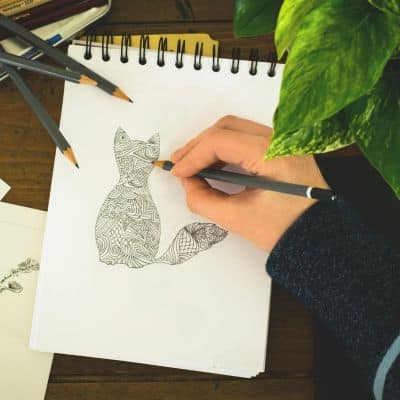
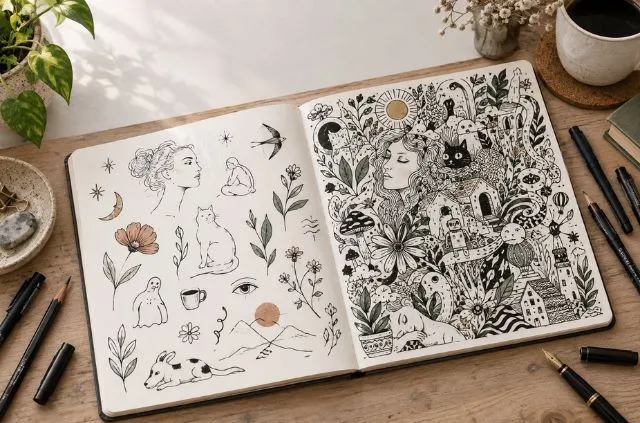
Doodling may look like a simple way to fill an empty corner of a notebook, but some artists have turned those spontaneous lines into recognisable creative styles. Understanding why people doodle also helps explain why such simple marks can become a meaningful part of an artist’s creative process.
From sketchbook drawings and playful characters to intricate patterns and large-scale walls, doodling has appeared in many forms throughout art history. Some artists became known specifically for doodle art, while others used spontaneous sketches, symbols, lines, and repeated motifs as an important part of their wider artistic practice.
If you are still wondering what a doodle actually is, it is essentially a simple drawing made freely and often without a strict plan. Famous artists have shown that these seemingly casual marks can develop into illustrations, visual stories, patterns, murals, and even entire artistic identities.
What Makes Someone a Famous Doodle Artist?
A doodle artist does not necessarily create tiny drawings in the margins of a notebook.
Modern doodle art can include repeated characters, spontaneous lines, abstract patterns, handwritten words, cartoon figures, intricate pen drawings, and large-scale compositions.
Some artists create their work almost entirely from doodle-like marks, while others use loose sketches and spontaneous drawing as part of a much wider artistic practice.
That is why famous doodle artists can have very different styles.
15 Famous Doodle Artists to Know
1. Mr Doodle (Sam Cox)
When most people think of a modern artist specifically associated with doodling, Mr Doodle is one of the first names that comes to mind.
British artist Sam Cox, known professionally as Mr Doodle, developed a distinctive style he calls “Graffiti Spaghetti.” His drawings are packed with interconnected characters, faces, objects, patterns, and playful scenes.
His doodles have appeared on walls, furniture, buildings, clothing, and other large surfaces. His official exhibition history includes shows and projects around the world, including exhibitions in London, Madrid, Seoul, Tokyo, Hong Kong, and New York.
What makes Mr Doodle particularly interesting is the way he takes something usually associated with the corner of a notebook and expands it across an entire environment.
His work shows how repetition can turn hundreds of tiny doodles into one enormous composition.
| Detail | Information |
|---|---|
| Born | 1994, Kent, England |
| Status | Living artist |
| Field | Doodle art and contemporary illustration |
| Known for | “Graffiti Spaghetti,” interconnected characters, objects, patterns, and large-scale doodle compositions |
2. Joe Whale (The Doodle Boy)
Joe Whale, better known as The Doodle Boy, is a young British artist who became known for his imaginative black-and-white doodles and playful characters. His drawings are filled with quirky creatures, funny expressions, objects, and little scenes that seem to grow naturally across the page.
What makes Joe’s work particularly interesting is the way he turns simple pen drawings into busy visual worlds. Instead of treating each doodle as a separate picture, he connects characters, shapes, and ideas to create larger compositions.
His work shows that doodling can be playful without being complicated. A simple character or unusual shape can become the starting point for an entire drawing when you keep adding details and let your imagination guide the page.
For anyone who enjoys creating silly doodles, funny characters, or imaginative scenes, Joe Whale’s work is a great example of how a simple doodle can develop into a recognisable personal style.
| Detail | Information |
|---|---|
| Born | 2010, Shrewsbury, England |
| Status | Living artist |
| Field | Doodle art and illustration |
| Known for | Black-and-white doodles, playful characters, imaginative scenes, and large-scale doodle artwork |
3. Leonardo da Vinci
Leonardo da Vinci is one of the earliest names worth mentioning when talking about the tradition of drawing freely in notebooks.
Although he was not a modern doodle artist, his notebooks contain countless sketches, diagrams, observations, studies of nature, inventions, anatomy, and ideas. His drawings show how a page can become a place for thinking visually.
Leonardo often combined words, diagrams, measurements, and drawings rather than separating writing from sketching. This approach feels surprisingly familiar to modern visual note-taking.
His notebooks are a reminder that drawing does not always have to be a finished artwork. Sometimes a quick sketch is simply a way of exploring an idea.
| Detail | Information |
|---|---|
| Born | April 15, 1452, Vinci, Italy |
| Died | May 2, 1519, Amboise, France |
| Period | Italian Renaissance |
| Known for | Painting, drawing, scientific studies, inventions, and notebooks |
4. Pablo Picasso
Pablo Picasso is another famous artist whose simple line drawings demonstrate how much can be communicated with very few marks.
His minimalist drawings often reduce people, animals, and objects to flowing lines. Instead of filling the page with complicated details, Picasso could suggest an entire figure with a handful of confident strokes.
This is one of the most useful lessons for anyone learning how to draw doodles: simplicity can be more expressive than excessive detail.
A single continuous line can become a face, bird, flower, or figure when you focus on the most recognisable features.
| Detail | Information |
|---|---|
| Born | December 31, 1869, Le Cateau-Cambrésis, France |
| Died | November 3, 1954, Nice, France |
| Period | Modern Art |
| Known for | Fauvism, expressive line drawings, painting, cut-outs, and simplified forms |
5. Henri Matisse
Henri Matisse is especially interesting for people who enjoy simple, flowing line art.
His later drawings and cut-paper work demonstrate his ability to simplify forms while maintaining a strong sense of movement and personality. His line drawings of faces, bodies, plants, and figures show how elegant a minimal mark can become.
Matisse’s work can inspire doodlers to stop worrying about making every shape realistic. A few curved lines can be enough to suggest a complete subject. This approach can also be applied to simple plant doodles, where leaves and stems can be reduced to just a few expressive lines.
This approach works particularly well for botanical sketches, faces, leaves doodle, and other simple subjects. Easy flower doodles are a simple way to practise this kind of flowing line work.
| Detail | Information |
|---|---|
| Born | December 31, 1869, Le Cateau-Cambrésis, France |
| Died | November 3, 1954, Nice, France |
| Period | Modern Art |
| Known for | Fauvism, expressive line drawings, painting, cut-outs, and simplified forms |
6. Hattie Stewart
Hattie Stewart has helped push doodling into contemporary illustration and fashion culture.
The London-based artist became widely known for her playful “doodle-bombing” style, in which hand-drawn characters and colourful illustrations interact with existing photographs, magazine covers, and commercial imagery.
Her work demonstrates how doodles can transform something that already exists instead of starting with a completely blank page.
Creative Bloq has highlighted her distinctive graphic style, cover takeovers, and collaborations with major brands.
Her approach is particularly inspiring if you like adding faces, flowers, characters, speech bubbles, or funny details to photographs and illustrations.
| Detail | Information |
|---|---|
| Born | London, England |
| Status | Living artist |
| Field | Illustration and contemporary art |
| Known for | Doodle-bombing, colourful characters, magazine interventions, and playful graphic artwork |
7. Saul Steinberg
Saul Steinberg is one of the most important artists to consider when discussing drawing that sits between illustration, cartoons, visual thinking, and doodling.
He became famous for his work for The New Yorker, where his drawings often played with perspective, language, architecture, maps, and everyday life.
Steinberg showed that a simple line could become much more than decoration. His drawings often invite the viewer to look twice and think about what they are seeing.
His work is particularly useful inspiration if you enjoy doodles that combine ordinary objects with unexpected ideas.
| Detail | Information |
|---|---|
| Born | June 15, 1914, Râmnicu Sărat, Romania |
| Died | May 12, 1999, New York City, USA |
| Period | 20th-century illustration |
| Known for | Drawings, cartoons, visual humour, maps, and The New Yorker illustrations |
8. Keith Haring
Keith Haring helped make bold, simplified line drawing part of popular visual culture.
His instantly recognisable imagery included dancing figures, barking dogs, radiant babies, hearts, and energetic movement lines. His artwork often used strong outlines and simplified symbols that could be understood quickly.
The Whitney Museum notes that Haring developed his spontaneous, free-flowing style through his work in New York’s streets and subways.
Haring is an excellent example of how simple characters and symbols can become a complete visual language.
His influence can be especially useful when creating cool doodle ideas based on characters, movement, symbols, and expressive faces.
| Detail | Information |
|---|---|
| Born | May 4, 1958, Reading, Pennsylvania, USA |
| Died | February 16, 1990, New York City, USA |
| Period | Contemporary Art / 1980s |
| Known for | Bold line drawings, simplified figures, symbols, murals, and street art |
9. Jean-Michel Basquiat
Jean-Michel Basquiat is not usually described simply as a doodle artist, but his work included spontaneous-looking marks, symbols, words, figures, crowns, heads, and repeated visual motifs.
His style developed into a distinctive visual vocabulary that combined writing, drawing, painting, collage, and symbolism. MoMA describes his work as containing repetitive images, human heads, varied marks, and collage elements.
Basquiat demonstrates another side of doodling: the ability to combine words and drawings until they become one visual language.
For doodlers, his work can be a reminder that letters, symbols, arrows, faces, and random marks can work together rather than needing to remain separate.
| Detail | Information |
|---|---|
| Born | December 22, 1960, Brooklyn, New York, USA |
| Died | August 12, 1988, New York City, USA |
| Period | Neo-Expressionism |
| Known for | Symbols, words, figures, expressive marks, painting, and mixed-media work |
10. Sergio Aragonés
Sergio Aragonés is famous for his cartooning and his work for MAD Magazine, where his densely packed illustrations became a signature part of the publication.
His drawings are energetic, humorous, and filled with small characters and visual details. Rather than relying on one large focal point, his illustrations often encourage the viewer to explore the entire page.
That quality makes his work particularly relevant to doodling.
If you enjoy filling an empty page with tiny characters, funny situations, objects, and visual jokes, Aragonés offers plenty of inspiration. This same playful approach can be explored through silly doodles, where unusual expressions and exaggerated characters become part of the fun.
| Detail | Information |
|---|---|
| Born | September 6, 1937, Castellón de la Plana, Spain |
| Status | Living artist |
| Field | Cartooning and illustration |
| Known for | MAD Magazine, densely packed cartoons, tiny characters, and visual jokes |
11. Jon Burgerman
Jon Burgerman is a British-American artist and illustrator known for colourful, playful characters and energetic compositions.
His work sits comfortably between illustration, street art, graphic design, and doodle-inspired drawing. He often creates strange characters with expressive faces and fluid shapes.
Creative Bloq describes Burgerman’s work as colourful, fluid, and playful, with doodle-like compositions appearing in projects such as large-scale windows.
His work is a great example of how doodling can become character design. Instead of trying to create realistic people or animals, you can invent your own creatures and let their personalities come from their shapes and expressions. Even something as familiar as a cat doodle can become a character simply by changing its expression, pose, or proportions.
| Detail | Information |
|---|---|
| Born | 1979, Nottingham, England |
| Status | Living artist |
| Field | Illustration and contemporary art |
| Known for | Colourful characters, playful doodles, fluid shapes, and energetic compositions |
12. Visoth Kakvei
Visoth Kakvei is known for intricate hand-drawn illustrations that push doodling into highly detailed territory.
His work often features botanical forms, ornamental patterns, animals, and elaborate compositions. He also digitally enhances some of his drawings to create a sense of depth and movement.
Creative Bloq highlights his intricate hand-drawn doodle art and his use of digital enhancement to create additional depth and visual effects.
For anyone who enjoys detailed patterns, his work demonstrates how simple lines can gradually build into incredibly complex artwork.
It is also a useful reminder that doodling does not have to remain simple forever. A basic leaf, curve, dot, or spiral can become part of a much larger pattern.
| Detail | Information |
|---|---|
| Born | Cambodia |
| Status | Living artist |
| Field | Illustration and intricate doodle art |
| Known for | Highly detailed hand-drawn patterns, botanical forms, animals, and ornamental compositions |
13. Géraldine Georges
Géraldine Georges takes a more delicate and surreal approach to doodle-inspired illustration.
Her work combines photography with hand-drawn elements, creating unusual compositions where realistic images and imaginative drawings interact.
This approach demonstrates that doodling does not always have to mean filling an entire page with cartoon characters. A few carefully placed lines can completely change the mood of an image.
Creative Bloq describes her work as a blend of photography and illustration, with an emphasis on elegant and emotional collage.
Her style may appeal to anyone who enjoys combining drawing with journals, photographs, mixed media, or collage.
| Detail | Information |
|---|---|
| Born | France |
| Status | Living artist |
| Field | Illustration and mixed media |
| Known for | Combining photography with hand-drawn elements, delicate lines, and surreal compositions |
14. Eva-Lotta Lamm
Eva-Lotta Lamm is particularly important if you are interested in doodling as a form of visual note-taking.
Rather than simply decorating pages, she turns information from talks, presentations, and discussions into illustrated notes. Her sketchnotes combine words, symbols, drawings, arrows, and visual organisation.
Creative Bloq highlights her sketchnotes as a way of adding a visual element to traditional note-taking.
This is where doodling becomes especially practical. You do not have to create artwork simply for decoration. Small drawings can help organise information and make a page easier to scan. For a simpler classroom approach, easy doodles to draw when bored in class can show how small drawings can fit naturally around everyday school notes.
If this side of doodling interests you, doodle notes offer a useful way to explore the connection between drawing and learning.
| Detail | Information |
|---|---|
| Born | Germany |
| Status | Living artist |
| Field | Illustration and visual note-taking |
| Known for | Sketchnotes, visual thinking, symbols, hand lettering, and illustrated notes |
15. Mattias Adolfsson
Swedish illustrator Mattias Adolfsson is known for incredibly detailed sketchbook drawings filled with characters, machines, buildings, objects, and miniature stories.
His pages often look as though one small idea has led naturally to another until the entire page becomes an interconnected world.
Creative Bloq describes Adolfsson as an accomplished doodler and points to his impressive sketchbook pages as an example of his approach.
His work is particularly inspiring if you enjoy adding tiny details to your drawings.
Instead of drawing one object and stopping, you can ask yourself what might be beside it. Then add another object, a character, a tiny plant, a funny sign, or another small scene.
| Detail | Information |
|---|---|
| Born | 1965, Sweden |
| Status | Living artist |
| Field | Illustration |
| Known for | Detailed sketchbooks, miniature scenes, imaginative characters, machines, and intricate worlds |
16. Kerby Rosanes
Kerby Rosanes is known for highly detailed illustrations that combine animals, fantasy elements, patterns, and imaginative worlds.
His work demonstrates how doodle-style drawing can grow into complex illustrations filled with tiny details.
His intricate approach is especially interesting for people who enjoy drawing animals and turning them into larger compositions. A single animal can become the starting point for a whole imaginary scene.
Kerby Rosanes has also been recognised in discussions of contemporary doodle art, with his work described as helping give the art form a more elaborate and detailed visual direction. You can explore more of his online portfolio to see his detailed illustration style.
| Detail | Information |
|---|---|
| Born | Philippines |
| Status | Living artist |
| Field | Illustration and contemporary doodle-inspired art |
| Known for | Intricate animals, fantasy illustrations, patterns, and highly detailed compositions |
What Can We Learn From Famous Doodle Artists?
The biggest lesson from these artists is that there is no single definition of what a doodle has to look like.
Some artists use simple lines.
Others create complicated patterns.
Some draw tiny characters.
Others fill entire walls.
Some combine drawings with words, while others use doodling to record information or explore ideas.
Looking at different approaches can help you discover the kind of doodling you enjoy most.
Simple Lines Can Say a Lot
Artists such as Picasso and Matisse demonstrate how a few carefully placed lines can communicate an entire subject.
You do not need to add every detail.
Repetition Creates Visual Interest
Mr Doodle and other pattern-focused artists show how repeating characters, shapes, and symbols can turn individual doodles into a larger composition.
If you enjoy repetitive designs, experimenting with Zendoodle patterns can be a natural next step.
Characters Give Doodles Personality
Keith Haring, Jon Burgerman, and Mr Doodle demonstrate how simple characters can become memorable.
A circle with two eyes can already be a character. Change the expression, add arms, or give it an unusual accessory, and suddenly it has a personality.
Words and Pictures Can Work Together
Basquiat and Eva-Lotta Lamm show very different ways of combining words with images.
A doodle does not have to sit separately from your writing. Words, arrows, symbols, and drawings can become part of the same visual composition.
Doodles Can Become Illusions
Some artists take simple lines and patterns much further by playing with perspective, depth, repetition, and visual perception.
This is one reason illusion doodle art can be so fascinating. A page of ordinary lines can be arranged to create the impression of movement, depth, or three-dimensional space.
Doodling Can Be Personal
Perhaps the most important lesson is that you do not need to copy a famous artist to learn from them.
You can borrow an idea—a simple line, a repeated pattern, a funny character, a visual symbol—and develop it into something that feels like your own.
How to Start Doodling Like an Artist
You do not need expensive supplies or professional drawing skills.
A pencil, pen, notebook, or sketchbook is enough to begin.
Start with basic shapes such as:
- Circles
- Ovals
- Squares
- Rectangles
- Triangles
- Lines
- Spirals
- Waves
- Dots
Then experiment with turning those shapes into objects, characters, patterns, and scenes.
If you are completely new to doodling, start with a few easy drawing ideas before trying more detailed compositions.
You can also choose one theme and create a small collection around it. For example, draw five flowers, five animals, five faces, or five imaginary characters.
The goal is not to reproduce another artist’s style perfectly. It is to discover what happens when you keep drawing.
Can Doodling Be a Mindful Activity?
For many people, drawing repetitive lines, shapes, and patterns can become a quiet creative activity.
The process can encourage you to slow down and pay attention to what your hand is doing rather than worrying about whether the final drawing is perfect.
That is where mindful doodling comes in. Instead of treating doodling as something you do absent-mindedly, you can deliberately focus on the movement of your pen, the repetition of a pattern, or the small details appearing on the page.
Doodling can also be included among broader mindfulness art activities such as colouring, painting, pattern-making, and other creative exercises.
Famous Doodle Artists at a Glance
| Artist | Known For | Doodle Inspiration |
|---|---|---|
| Leonardo da Vinci | Notebooks and studies | Visual thinking |
| Pablo Picasso | Minimal line drawings | Simple outlines |
| Henri Matisse | Expressive line art | Flowing shapes |
| Saul Steinberg | Illustration and visual humour | Clever concepts |
| Keith Haring | Symbols and expressive figures | Simple characters |
| Jean-Michel Basquiat | Words, symbols and marks | Visual language |
| Sergio Aragonés | Cartooning | Tiny characters |
| Mr Doodle | Dense doodle compositions | Repetition |
| Jon Burgerman | Playful characters | Character doodles |
| Visoth Kakvei | Intricate doodles | Detailed patterns |
| Hattie Stewart | Doodle-bombing | Decorative characters |
| Géraldine Georges | Photography and illustration | Mixed media |
| Eva-Lotta Lamm | Sketchnotes | Visual note-taking |
| Mattias Adolfsson | Detailed sketchbooks | Tiny scenes |
| Kerby Rosanes | Detailed fantasy illustrations | Imaginative compositions |
Final Thoughts
Doodling has travelled a long way from the quiet drawings people make in the margins of notebooks.
Artists have used simple lines, symbols, characters, patterns, words, and spontaneous sketches to create everything from tiny illustrations to enormous compositions. Some became famous specifically for doodling, while others showed how doodle-like thinking could influence illustration, painting, cartooning, street art, and visual communication.
The fascinating part is that there is no single right way to doodle.
You can keep your drawings tiny and simple, fill a page with repeating patterns, create funny characters, experiment with optical effects, or combine words and images.
The artists above simply show what is possible when you keep drawing and allow simple ideas to develop into your own visual language.
Frequently Asked Questions
Mr Doodle, the professional name of British artist Sam Cox, is one of the most recognisable contemporary artists specifically associated with doodle art. His dense, interconnected drawings have appeared across walls, furniture, buildings, and other large surfaces.
There is no single person who invented doodle art. People have been making informal sketches and marginal drawings for centuries. Artists such as Leonardo da Vinci kept notebooks filled with drawings and visual studies, while later artists helped develop doodle-like approaches into recognised artistic styles.
Keith Haring is more accurately described as an American artist and social activist associated with pop and street art, rather than simply a doodle artist. However, his bold lines, simplified figures, symbols, and spontaneous-looking drawings have had a strong influence on doodle-inspired art.
Mr Doodle is famous for his dense, playful drawings filled with interconnected characters, objects, patterns, and symbols. His style is often associated with his “Graffiti Spaghetti” approach, in which doodles cover surfaces in an almost continuous visual network.
You can learn that doodles do not need to be complicated to be effective. Famous artists demonstrate different approaches, including simple line drawing, repeated patterns, character design, visual storytelling, lettering, symbolism, and detailed illustration.
Yes. One of the easiest ways is to practise the same basic subjects repeatedly while changing their shapes, expressions, patterns, and details. Over time, certain lines, characters, symbols, or patterns will naturally become part of your own style.
Not necessarily. Doodling can begin with very basic shapes and simple marks. Artistic skill develops through practice, but a doodle does not have to be technically perfect to be expressive, interesting, or enjoyable.