

If you’re wondering how to say i love you in spanish, the two main expressions are Te amo and Te quiero. Both can express love, including romantic love. The choice depends on your relationship, the situation and how people use these phrases in their Spanish-speaking community.
You might be writing your first romantic message, replying to a partner or sending something affectionate to your mum. You don’t need a long sentence to make it meaningful. A few well-chosen words can say exactly what you feel.
How to Say I Love You in Spanish
Te amo and Te quiero both mean “I love you” when you’re expressing love for someone. Neither is limited to one relationship or one country.
| Spanish phrase | English meaning | Common use |
|---|---|---|
| Te amo | I love you | A direct declaration of love; can sound deeply romantic |
| Te quiero | I love you / I care deeply for you | A very common affectionate expression between partners, family members and close friends |
For a straightforward message, either phrase can stand alone:
- Te amo. — I love you.
- Te quiero. — I love you.
You don’t need to add yo, meaning “I”. The verb already tells the listener who’s speaking. Yo te amo is also correct, but the extra pronoun can emphasise the speaker, depending on the conversation.
If you’re choosing a phrase for someone who speaks Spanish, notice which expression they use with you. Their own habits are more helpful than a rule claiming that everyone in a particular country says the same thing.
Te Amo vs. Te Quiero: What’s the Difference?
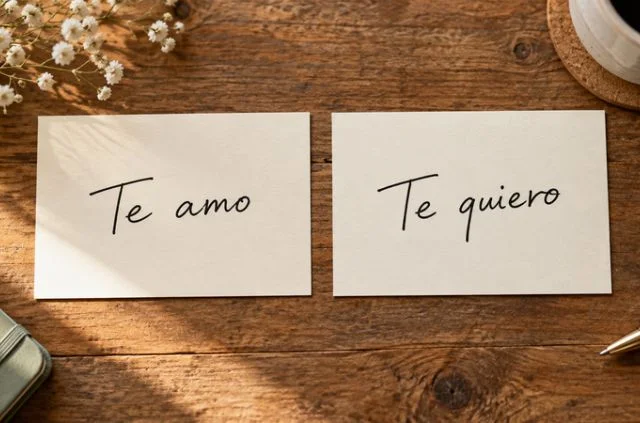
Te amo can sound especially direct or deeply romantic in many contexts, while te quiero is also widely used between romantic partners. There’s no universal scale that makes one phrase sincere and the other less meaningful.
What does “Te amo” mean?
Te amo means “I love you”. It comes from amar, the verb “to love”. The Real Academia Española’s entry for amar defines it as having love for someone or something.
You might say it during a heartfelt conversation, write it in an anniversary card or use it every day with your partner. In some households, it’s also a familiar expression between parents and children.
Te amo. Me alegra compartir mi vida contigo.
“I love you. I’m happy to share my life with you.”
What does “Te quiero” mean?
Te quiero expresses love or affection for the person you’re addressing. Although querer can mean “to want” in other sentences, translating this affectionate expression as “I want you” misses its usual meaning.
The RAE’s entry for querer includes loving or feeling affection for someone among its meanings. That matters: te quiero isn’t just a polite substitute for love.
Te quiero. Gracias por estar conmigo.
“I love you. Thank you for being with me.”
A romantic partner can say this with complete sincerity. It can also fit a warm message to a sibling, parent or close friend.
Which one should you choose?
Think about the person and the moment. Te amo may feel like a significant declaration to one speaker and an everyday expression to another. Te quiero may feel gentle, intimate or deeply committed, depending on who’s saying it.
Usage varies across Spanish-speaking regions, families and individuals. English speakers shouldn’t assume that the two phrases map neatly onto “serious love” and “casual affection”. If you’re unsure, a simple question about what sounds natural to your partner can become a lovely conversation in itself.
How to Pronounce “Te Amo”
Te amo is pronounced roughly “teh AH-moh”. Put the emphasis on AH, and keep the vowels short and clear.
| Spanish phrase | Rough pronunciation for English speakers |
|---|---|
| Te amo | teh AH-moh |
| Te quiero | teh KYEH-roh |
| Te amo mucho | teh AH-moh MOO-choh |
| Te quiero mucho | teh KYEH-roh MOO-choh |
These spellings are approximate sound cues, rather than exact phonetic transcriptions.
A few small details help:
- Te sounds like “teh”, not “tee”.
- The a in amo is an open “ah” sound.
- The qu in quiero makes a “k” sound. The u is silent, as the RAE’s pronunciation guidance for u explains.
- Quiero has two syllables: quie-ro. Keep “kyeh” together rather than saying “kee-air”.
- The single r in quiero is usually a quick tongue tap, rather than a long rolled sound.
- The ch in mucho sounds like the “ch” in “chair”.
Try the words slowly, then join them into one comfortable phrase. Spanish o is a steady vowel; the English “oh” cue can tempt you to stretch or change it more than necessary. Your message doesn’t need a flawless accent to be understood.
How to Say “I Love You Too” in Spanish
Yo también te amo and Yo también te quiero are natural ways to say “I love you too” in Spanish. También means “too” or “also”.
You can also say:
- Te amo también. — I love you too.
- Te quiero también. — I love you too.
- También te amo. — I love you too.
- También te quiero. — I love you too.
A simple conversation looks like this:
“Te amo.” — “Yo también te amo.”
“I love you.” — “I love you too.”
Or, with querer:
“Te quiero.” — “Yo también te quiero.”
“I love you.” — “I love you too.”
In an obvious context, Yo también alone means “Me too”. Y yo a ti is another affectionate reply, meaning “And I love you”, with the verb understood from what the other person has said.
Repeating their phrase is an easy option for beginners. Remember the accent in también when writing your reply.
How to Say “I Love You So Much” in Spanish
Te amo mucho and Te quiero mucho can both express “I love you so much”. For stronger emphasis, use muchísimo.
| Spanish phrase | Natural English meaning | Tone |
|---|---|---|
| Te amo mucho | I love you very much / so much | Direct and affectionate |
| Te quiero mucho | I love you very much / so much | Warm; suitable for partners and other loved ones |
| Te amo muchísimo | I love you so much | Especially emphatic |
| Te quiero muchísimo | I love you so much | Especially emphatic and affectionate |
Mucho means “a lot” or “very much” here. Muchísimo adds emphasis, rather like saying “so very much”.
For a message after a good day together:
Te quiero mucho. Hoy lo he pasado muy bien contigo.
“I love you so much. I’ve had a lovely time with you today.”
For someone you haven’t seen recently:
Te amo muchísimo. Tengo muchas ganas de verte.
“I love you so much. I really want to see you.”
Choose the version that fits how you normally speak to each other. Adding a more emphatic word doesn’t automatically make a message more heartfelt.
How to Say “I Love You More” in Spanish
Te amo más means “I love you more”. Te quiero más works too, especially if you’re replying to te quiero.
Here’s a playful exchange:
“Te amo.”
“I love you.”
“Te amo más.”
“I love you more.”
You can also reply Yo más, meaning “Me more” in this understood, playful context. It isn’t a complete literal translation of “I love you more”, but it makes sense after a declaration of love.
Keep the accent in más. The exchange is usually affectionate teasing; it doesn’t need to become a comparison of who cares most.
Sweet Ways to Say “I Love You” in Spanish
Spanish has plenty of ways to express affection beyond the two main phrases. Some directly state love, while others describe what the person means to you.
| Spanish phrase | English meaning | Context or tone |
|---|---|---|
| Te adoro | I adore you | Enthusiastic affection; can be romantic or playful |
| Te quiero muchísimo | I love you so much | A warm, emphatic message |
| Te quiero con todo mi corazón | I love you with all my heart | Heartfelt; lovely in a personal card |
| Eres el amor de mi vida | You’re the love of my life | A significant romantic declaration |
| Eres mi vida | You’re my life | Intense and affectionate; best where that tone feels welcome |
| Te quiero más de lo que imaginas | I love you more than you imagine | Tender reassurance |
| Mi corazón es tuyo | My heart is yours | Poetic and openly romantic |
| Estoy enamorado de ti | I’m in love with you | Masculine speaker form |
| Estoy enamorada de ti | I’m in love with you | Feminine speaker form |
In estoy enamorado de ti and estoy enamorada de ti, the ending describes the speaker, not the person receiving the message. A masculine speaker uses enamorado; a feminine speaker uses enamorada, regardless of their partner’s gender.
By contrast, te amo and te quiero don’t change according to either person’s gender.
You can add mi amor, meaning “my love”, to a phrase you already like. Affectionate terms such as this belong among romantic names in Spanish, but you only need one that feels comfortable between you.
Romantic Spanish Phrases for Your Boyfriend or Girlfriend
Te quiero, mi amor means “I love you, my love” and works for a boyfriend or girlfriend. Other useful messages tell your partner how they make you feel or why you’re thinking of them.
Here are a few you could actually send:
- Me haces muy feliz. — You make me very happy. A lovely message after spending time together.
- No puedo dejar de pensar en ti. — I can’t stop thinking about you. Romantic and a little intense.
- Siempre estás en mi corazón. — You’re always in my heart. Tender, especially when you’re apart.
- Qué suerte tengo de estar contigo. — I’m so lucky to be with you. Appreciative without being elaborate.
- Te quiero. Que tengas un buen día. — I love you. Have a good day. Simple enough for an everyday text.
A morning message could be Buenos días, mi amor. Te quiero, meaning “Good morning, my love. I love you”. These good morning expressions in Spanish fit naturally beside a short declaration of affection.
For a compliment, Estás guapo or Estás guapa means “You look handsome” or “You look beautiful”. Here, the ending describes the person you’re addressing. The wording for how to say someone is beautiful in Spanish depends on the compliment and context.
The most personal message often combines one love phrase with one true detail. Te quiero. Me encanta tu sonrisa means “I love you. I love your smile”. It’s short, specific and easy to understand.
How to Say “I Love You” to Your Mom in Spanish
Te quiero, mamá, Te amo, mamá and Te quiero mucho, mamá are natural ways to say “I love you, Mom” in Spanish. Which feels most familiar depends on regional and family usage.
- Te quiero, mamá. — I love you, Mom.
- Te amo, mamá. — I love you, Mom.
- Te quiero mucho, mamá. — I love you very much, Mom.
- Gracias por todo, mamá. Te quiero. — Thank you for everything, Mom. I love you.
The accent in mamá marks the stress on the final syllable. In writing, the comma separates the message from the person being addressed.
Both te quiero and te amo can be used with family. Neither is reserved exclusively for romantic partners.
For your dad, Te quiero, papá means “I love you, Dad”. For your grandmother, Te quiero, abuela means “I love you, Grandma”. You can also use someone’s name: Te quiero mucho, Ana.
Other Ways to Express Love Without Saying “Te Amo”
Me haces feliz means “You make me happy”, and Eres muy importante para mí means “You’re very important to me”. They communicate affection without literally saying “I love you”.
That distinction matters, especially if you’re still getting to know someone.
| Spanish phrase | English meaning | What it communicates |
|---|---|---|
| Me encantas | I’m really into you / I find you wonderful | Attraction or strong delight in the person; context matters |
| Eres muy importante para mí | You’re very important to me | Appreciation and emotional significance |
| Me haces feliz | You make me happy | How their presence makes you feel |
| Pienso en ti | I think about you / I’m thinking of you | That they’re on your mind |
| Te extraño | I miss you | Missing their company |
| Siempre estaré a tu lado | I’ll always be by your side | A promise of support or commitment |
Te echo de menos also means “I miss you” and is especially common in Spain. Te extraño is common in many Latin American varieties. Both express missing someone rather than declaring love by themselves.
Similarly, Eres el amor de mi vida is a romantic declaration meaning “You’re the love of my life”, not a word-for-word translation of “I love you”. It’s a much bigger statement than simply telling someone they’re on your mind.
Choose a phrase that matches your feelings. Pienso en ti can be a thoughtful text without making a promise about the future.
“I Love You” in Spanish for Different Situations
Use this table to choose a phrase quickly. The situations are examples, rather than strict limits on who can use each expression.
| Situation | Spanish phrase | English meaning |
|---|---|---|
| Romantic partner | Te amo | I love you |
| Romantic partner | Te quiero | I love you |
| Saying it back | Yo también te amo | I love you too |
| Strong affection | Te amo muchísimo | I love you so much |
| Playful response | Te amo más | I love you more |
| To mom | Te quiero, mamá | I love you, Mom |
| Sweet message | Te quiero con todo mi corazón | I love you with all my heart |
| Close friend | Te quiero mucho | I love you very much |
| Missing your partner | Te extraño | I miss you |
For the word love on its own, use amor when you mean the noun and amar when you mean the verb “to love”. In affectionate sentences, querer can also mean “to love”, as in te quiero.
Keep accents when copying a message, particularly in también, más, mamá, muchísimo and corazón. They belong to the words, rather than being optional decoration.
Frequently Asked Questions
Te amo and Te quiero both express “I love you”. Their tone and use depend on your relationship, the situation and the speaker’s community and personal habits.
Te amo can sound especially direct or deeply romantic. Te quiero is a common expression of love and affection, including between romantic partners. There’s no universal rule that makes one always deeper than the other.
Say Yo también te amo or Yo también te quiero. Te amo también and Te quiero también are also correct. In a clear conversation, Yo también can mean “Me too”.
Use Te amo mucho or Te quiero mucho. For extra emphasis, say Te amo muchísimo or Te quiero muchísimo.
Te amo más means “I love you more”. Te quiero más is another natural option, particularly in response to te quiero.
Te amo means “I love you”. It comes from amar, meaning “to love”, and can express love for a romantic partner or family member, depending on usage.
Yes. Te quiero can express genuine romantic love. It isn’t limited to friendship, family affection or casual relationships.
Te quiero, mamá and Te amo, mamá both work. Te quiero mucho, mamá means “I love you very much, Mom”. Choose the expression that fits your family’s way of speaking.
Choose the Words That Feel Like You
Te amo and Te quiero are both real expressions of love. The best choice is the one that feels natural in your relationship, not the one someone ranks as more romantic.
For a first message, keep it simple: Te quiero, mi amor or Te amo. Add a personal detail if you like, and let the words reflect what you actually feel.
