What if drawing didn’t have to be perfect to be beautiful? Learning how to draw doodles is all about simple lines, fun ideas, and zero pressure. Whether you’re completely new to drawing or just looking for easy creative ideas, doodling is one of the simplest ways to get started.
In this beginner-friendly guide, you’ll learn how to doodle step by step. It is designed for beginners and uses easy techniques, simple shapes, and fun ideas that anyone can try—no experience needed.
What Is Doodling?
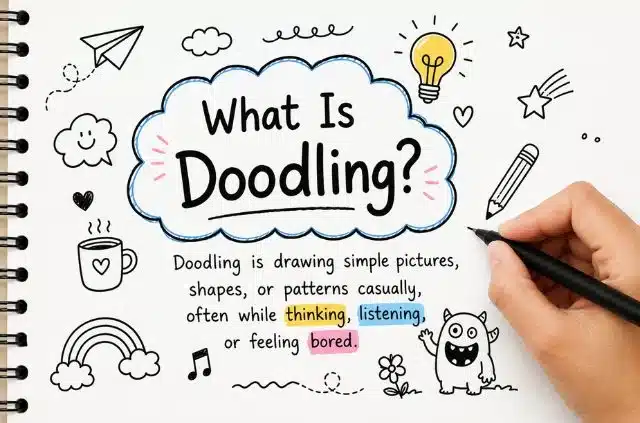
Doodling is simply drawing in a spontaneous and informal way. Many people think that learning how to doodle is difficult, but it is actually very simple. Doodles do not need to follow strict rules like traditional illustrations or fine art. For example, creating a page full of repeated patterns, drawing tiny cacti in the corners of notebooks, or simply letting your pen drift into abstract circles while you are on a phone call are all examples of doodling.
Doodling is unique because it is completely freeform. When you are learning to doodle, there are no rules to follow. Whether you draw a stick figure, a line of small stars, or a mix of different designs, you are still successfully doodling. Doodling gives you the opportunity to be creative. Once you start, you often enter a “flow” state that brings calmness and relaxation. This is why learning how to draw doodles is more about enjoying the process than following strict rules.
Why Learn/ Teach to Doodle?
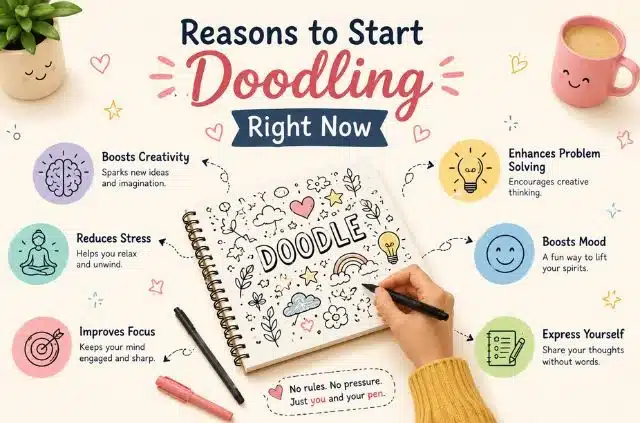
Doodling offers many benefits because it is simple and flexible. Here are some of the key advantages of doodling:
Benefits of Drawing and Doodling
Creating a doodle is just as valuable as being able to accurately draw a cute doodle or a cool sketch – there is also an aspect of mental, emotional, and creative well-being benefit to you. Regardless of whether you create doodles during school or work, or do so with your own time; this small act will have a beneficial impact on your mind and productivity.
Better Focus and Staying on Task:
When you doodle, you are stimulating your mind to stay active whilst you listen to something or are thinking about something; scientific research has shown that doing light drawings helps maintain your focus and keep you from being distracted while doing long presentations and listening to them.
Decreased Anxiety and Stress:
The relaxation you receive from doodling is one of its best benefits. It helps you slow down, feel calmer, and less overwhelmed—almost like a form of simple meditation. From a psychology perspective, doodling keeps the brain lightly engaged, which reduces mental overload and helps improve focus.
Increased Creativity:
Doodling generates free thought. Your brain will naturally produce new concepts by generating ideas without any rules. Over time, this will enhance your ability to create in art plus your creative problem-solving skills in everyday situations.
Enhanced Memory:
Creating simple doodles whilst you are in the process of learning something will enhance how well you remember the information you learn. Visual aspects help your brain retain and recall the details. Studies show that combining visuals with learning improves memory retention.
Increased Confidence in Your Ability to Draw:
If you believe that you cannot draw, you can begin your ability to draw by practicing such a simple way as doodling.
Mindful Awareness
Doodling is a simple way to practice being present in the moment—especially through mindful doodling, where you focus completely on each line and shape you create. This kind of awareness helps you notice how you’re feeling emotionally and physically, allowing you to step back from stress, overthinking, or anxiety about things like tests, performances, or daily pressures.
Also Read: Mindfulness Art Activities
Makes Learning and Note-Taking Fun
Doodling in your notes can turn ordinary pages into creative doodle notes that feel more:
- Engaging
- Easier to comprehend
- Aesthetically pleasing
Adding small doodles, icons, or patterns to your notes makes studying feel less boring and more visual. This is especially helpful for students who get restless during lectures or easily distracted while studying. Even simple doodling for class when bored can help you stay focused while making your notes more interesting and memorable.
Basic Tools You Need Before Starting Doodling
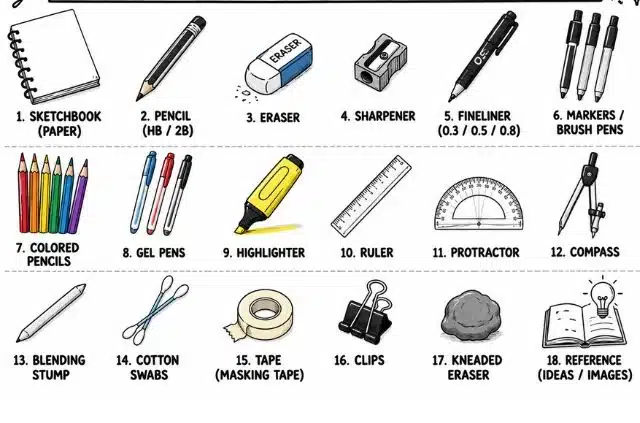
One of the best things about doodling is how little you need to begin. Here’s a simple breakdown:
The least amount of materials: The only requirements for doodling are some sort of writing tool, like a pen or pencil, and some kind of paper – and I mean any kind of paper! You can doodle on anything from a napkin to a sticky note to the margin of your notebook; as long as you write down whatever you’re doodling, you can use anything as a canvas.
Step up from that: You could use fine-liner pens in different sizes (for example, 0.3 mm, 0.5 mm, 0.8 mm). Each of these sizes will allow you to create different types of detail with your doodles. Use the smaller-sized pen for fine detailing and the larger pen for outlines. Some very popular brands with doodlers are Staedtler, Micron, and Uni PIN.
Adding color: You have lots of options for coloring your doodles, including using colored markers, pencils, or paint (acrylics and watercolors both work well). If you don’t have a lot of colors, you can still make a huge impact with two to three colors!
Circles and curves: When you need a perfect circle or curved shape, it is helpful to have a small compass or circle template; this is especially useful for drawing mandalas! For anything else, making an approximate hand-drawn circle only adds to the character of your doodle.
If you want to go digital: There are plenty of apps available for making doodles digitally if you prefer that over drawing on paper — such as Adobe Fresco, Procreate (on an iPad), or even free programs such as Sketchbook — that work great for doodling!
Core Techniques: How to Draw Doodles (Step-by-Step Guide)
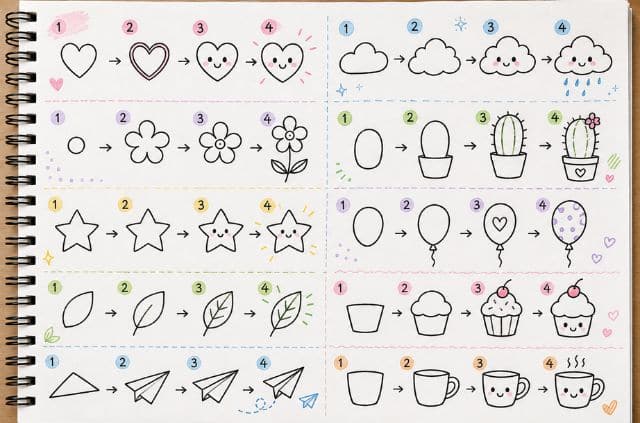
1. Warm Up First!
Before you can do something, you have to stretch your body and get it ready for the task that lies ahead; the same goes for warming up your hand before you begin to draw lines. Take a blank piece of paper and find out how long you can draw for (set your timer for ten minutes) and draw all sorts of things no matter how boring or uninteresting to you (examples: lines, shapes, loops, words, etc…) in a free-flowing manner and do not lift your writing utensil from the paper during that time, nor should you be judgmental by thinking about what you are drawing or that you are not good at it but rather concentrate on loosening up your grip and getting into the theory behind drawing.
2. See Everything as Basic Shapes
This is by far the single most valuable perspective change for beginning doodlers seeing things as very basic shapes before you try to draw. After you find something to draw go ahead and squint your eyes to look at it and try to picture simply what shapes make up that object? (Example: A flower is made up of a large circle in the middle surrounded by smaller oval-shaped petals.) A cactus is made using a rectangle with two rounded corners and one rounded bottom. A mug is like a large “C” shape as well as an upside-down “U” shape with a hole cut out to attach it together! Once you’ve been able to determine the geometric shapes used to create an object, drawing that object will now no longer be as intimidating. This method makes it much easier to understand how to draw doodles for beginners.
4. Do a Light Sketch in Pencil Then Use Ink for a Polished Look
Starting from your sketches with a pencil first will help with creating a more polished final product drawing in ink because you will be able to work out where all of the shapes and proportions go roughly, and once you have finished sketching everything out you can outline all of those shapes with a thin-tipped pen before erasing all the pencil lines below it.
5. Provide a Correcting Phase for Things
A basic doodle looks like a beautiful one, except that the details come afterwards and not before. First create a large overall form or basic outline of your complete form before adding any small items — like the texture line on leaves or spiders or the little dots in flowers — which are called “details.” Then add the details or features that give character to your doodle.
6. Draw the Outside Edge With a Strong Marker
Use a slightly thicker pen to draw over the outermost edge of your doodle. If you use too thick a marker you will create a broad outline for your doodle, however, if you use a wide enough space you will be making it look very intentional. Illustrators use this technique all the time.
7. Add Some Shadows or Color
Adding shadows or colors can take your doodles to the next level. You could use parallel shading, called hatching, or tiny dots for shading, called stippling, to create depth to the doodles. For adding color to your doodles you can use a clean solid fill or blend your doodles with colored pencils to make it more subtle.
Different Types of Doodles You Can Try When Learning
When you’re doodling, you will naturally feel more attracted to certain styles than others. Below are five different types of doodles you can experiment with. You can also explore the work of famous doodle artists to see how different artists use patterns, characters, line work and everyday objects in their own distinctive ways.
Zentangles and Zendoodle Patterns
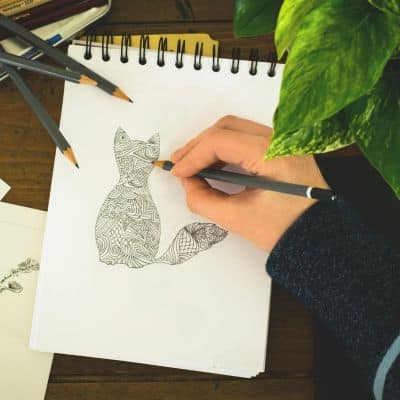
These types of doodles are a form of meditation based on repeating patterns that can be found in nature such as grids or waves or spirals; they are mainly drawn in black and white. Every little section of your drawing will be filled with a different type of repeating pattern as you create the Zentangle. This type of drawing is very calming and allows for unlimited creativity.
Mandala
These types of doodles consist of circular designs that radiate outward in symmetrical shapes from a central point. Mandalas have become popular for their ability to create a meditative state when drawing and how they provide a satisfying balance visually. You can create mandalas without the use of a ruler or with the help of a circle template.
Kawaii/Cute Characters
These types of doodles come from the Japanese way of creating caricatures of everyday items (like strawberries and clouds) by adding large eyes and facial expressions to them. A strawberry may be drawn smiling while a cloud could have an open mouth with sound coming out of it, or a laptop could have an excited expression. All three examples would look adorable and would be great for beginners.
Bullet Journal Doodles
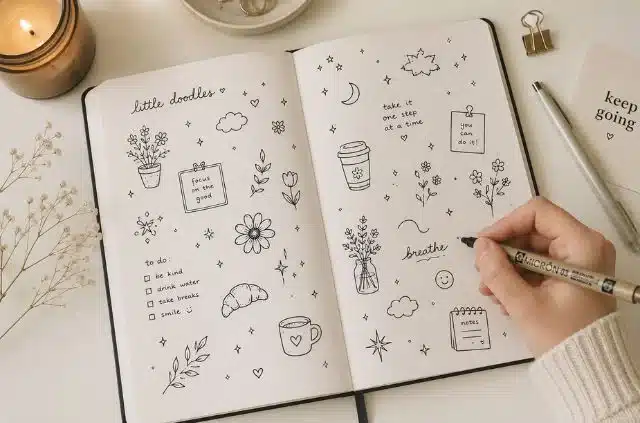
These types of doodles are simply decorative drawings that enhance journals or planners, such as a banner across the top of your planner or a border around your journal, small flowers, icons representing each season, and small pictures. These types of doodles are both decorative and practical.
Freeform/Abstract Doodles
These types of doodles have no theme and no plan, but rather are created with the intent of allowing the pen to go wherever it wants, They are very expressive and are therefore used for unwinding after a stressful day. There is no right and wrong when doing freeform doodles.
Illusion Doodle Art
Illusion doodles use lines, shapes, shading, and perspective to create the appearance of depth, movement, or 3D effects. They are a fun way to experiment with patterns and make a simple doodle look visually surprising.
Simple and Cool Doodle Ideas To Draw
Not sure where to start? Here are some beginner-friendly doodle and easy drawing ideas organized by theme:
Nature: Leaves, flowers, vines, mushrooms, cacti, succulents, raindrops, clouds, mountains
Food and drink Doodles: Coffee cups, ice cream cones, fruit slices, cakes, avocado, ramen bowls
Animals: Cat faces, birds, simple fish, dinosaurs, bees, jellyfish, bunny (Rat) doodle
Everyday objects: Lightbulbs, books, cameras, envelopes, keys, crowns, candles
Space and fantasy: Planets, stars, crescent moons, rockets, crystals, potion bottles
Silly and funny doodles: Goofy faces, dancing vegetables, sleepy coffee cups, animals wearing glasses, smiling clouds, melting ice cream with expressions, or random stick figures doing funny poses
Once you feel comfortable drawing these basic objects, try combining them into a single seasonal theme. These simple summer doodles to draw bring together beginner-friendly shapes to create beaches, tropical fruit, flowers, vacation icons, sunshine, and cheerful outdoor scenes.
Challenge idea: Choose a single theme — say, “the ocean” or “a cozy bedroom” — and fill one whole page with 20 different doodles related to it. This kind of focused practice builds your visual vocabulary fast.
Tips for Building a Doodle Habit
When you start, it is pretty simple, but it is in the sticking with it that you develop. Here are several ideas to help you:
- Keep doodle materials readily available, by having a pen and little notepad out on your desk or by your bedside, so you will not have to take time to set up the materials for creating the doodle.
- Find your own comfy zone. Doodling usually works better when you feel relaxed — that could be your comfy chair, café, or some quiet little corner; wherever you feel the most comfortable or relaxed.
- Do not compare your doodling to the doodling of anyone else. Your doodles should not resemble anyone else’s doodles; how you draw a teapot will be different from the way that someone else draws a teapot. This is not a mistake; It is your style evolving.
- Doodle the same subject in many ways. Select one object (i.e. leaf, house, star) and create ten completely unique drawings. This exercise will quickly help you to develop a visual identity that is yours.
- If you get stuck, you can use several different sources for doodling prompts. Use sites like Instagram and Pinterest to look for doodling prompt lists. If you search by “doodle of the day challenge” on these sites, you will easily find many pre-existing daily prompts for your use.
- Try doodling in small spurts. Even a simple 5- to 10-minute session of doodling each day can yield significant progress over the course of several weeks and months.
FAQ (How to Make Doodles – Beginner Questions)
Do I need any drawing experience to start doodling?
No experience is needed. Doodling is one of the most beginner-friendly creative activities — all you need is a pen and paper. The focus is on free, spontaneous marks rather than precise drawing, so anyone can start right away.
What supplies do I need to start doodling?
The bare minimum is any pen or pencil and a piece of paper. As you progress, fine-liner pens in different nib sizes, colored markers, and a sketchbook can enhance your results — but none of these are required to begin.
What are the easiest things to doodle for beginners?
Great starting points include simple flowers, leaves, coffee cups, stars, clouds, hearts, and basic animal faces. These shapes are built from circles, ovals, and lines — the simplest elements in drawing.
How long does it take to get good at doodling?
Most beginners see noticeable improvement within a few weeks of daily practice, even with just 10–15 minutes a day. Doodling is a skill that builds gradually — consistency matters far more than the length of each session.
What are the different styles of doodling?
Popular styles include Zentangle (structured repeating patterns), mandalas (circular symmetrical designs), kawaii (cute characters with expressive faces), freeform abstract doodling, and bullet journal doodles used to decorate planners.
Is doodling good for mental health?
Yes. Research suggests doodling can reduce stress, improve focus, and provide a calming creative outlet. Many people find repetitive doodle patterns — like zentangles or mandalas — particularly meditative and relaxing.
Can I doodle digitally instead of on paper?
Absolutely. Apps like Procreate (iPad), Adobe Fresco, and Sketchbook are popular choices for digital doodling. They offer the same creative freedom as paper but with the added benefit of easy undo and a variety of digital brushes.
How do I find my own doodling style?
Draw the same subject in as many different ways as you can — vary the shapes, line weight, and level of detail. Over time, your natural preferences will emerge. Your style develops through practice, not by copying someone else’s approach.
Who can doodle?
Anyone can doodle—kids, students, beginners, or even professionals. You don’t need any drawing skills; doodling is all about simple, freehand creativity and having fun.
You’re Ready to Start
Doodling is not something that you either can do or cannot do. Doodling is something that you will develop through practice in the same way as any other skill. Every professional illustrator started out with shaky lines and misshapen circles, they have the advantage of time and repetition, but ultimately they are not much different than you.
All you need to do is find a pen, get to a quiet spot, and begin doodling. There does not have to be a final outcome. There does not have to be a finished piece of art. All you need is to get started! Now that you understand how to draw doodles, the key is to practice regularly and enjoy the process without worrying about perfection.
Good luck with your doodles!