Have you ever drawn a few lines on a page and suddenly made a flat piece of paper look like it has depth?
That is the fun of illusion doodle art.
These doodles use simple tricks such as curved lines, repeating patterns, shading, overlapping shapes, and changes in perspective to make drawings appear three-dimensional or visually confusing. The best part is that you do not need to be an experienced artist to try them.
If you already enjoy simple doodling, illusion drawings are a natural next step. A few carefully placed lines can turn an ordinary circle into a tunnel, a group of squares into floating blocks, or a pattern into something that seems to move.
And don’t worry if your first attempt looks a little wonky. Mine would too. That’s part of the charm.
If you’re completely new to doodling, it can help to understand what a doodle is before experimenting with more structured illusion drawings.
What Is Illusion Doodle Art?
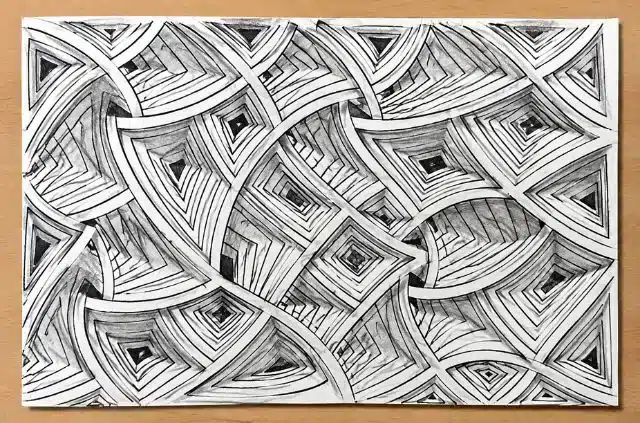
Illusion doodle art is a type of drawing that uses visual tricks to make flat lines and shapes appear to have movement, depth, dimension, or another unexpected effect.
Unlike realistic drawing, illusion doodles don’t necessarily try to make an object look exactly like it does in real life. Instead, they play with the way our eyes interpret shapes.
For example, a simple set of curved lines can make a flat page look like a:
- tunnel
- staircase
- hole
- wave
- spinning pattern
- 3D cube
- floating object
- twisted ribbon
- optical maze
Some illusion doodles are incredibly simple. Others become surprisingly complicated once you start combining patterns.
Why Do Illusion Doodles Look 3D?
The trick usually comes down to how lines and shapes are arranged.
When lines gradually change size, overlap one another, or curve toward a central point, our brains can interpret them as depth. Adding darker shading to one side of an object can strengthen the effect.
For instance, imagine drawing several squares inside one another. If each square becomes slightly smaller as it moves toward the centre, the page can suddenly look like a tunnel.
The drawing hasn’t actually changed depth.
Your eyes are simply being persuaded to see it that way.
Illusion Doodles vs. Ordinary Doodles
A regular doodle might be a quick flower, face, star, animal, or random pattern created without much planning. Even simple cool doodle ideas can become the starting point for an illusion drawing when you add perspective, repeated lines, overlapping shapes, or shading.
An illusion doodle usually has a little more structure.
You might begin with a simple shape and then deliberately manipulate:
- perspective
- spacing
- repetition
- line direction
- shading
- symmetry
- negative space
- overlapping forms
That doesn’t mean illusion doodles have to be complicated. In fact, some of the most satisfying ones begin with nothing more than a circle and a pencil.
Doodling itself is often less planned than traditional drawing. People may start making shapes, spirals, cubes, or random patterns simply because their hands are moving while their minds wander, which is part of the reason why people doodle. Illusion doodles take that simple habit and add a little more intention through perspective, repetition, and shading.
Easy Illusion Doodle Art Ideas for Beginners
You don’t need expensive supplies for these drawings.
A pencil, black pen, ruler, eraser, and a sheet of paper are enough to get started. Coloured pencils or markers can be added later if you want to make the finished doodles stand out.
Here are some easy illusion doodle ideas to try.
1. 3D Cube Doodle
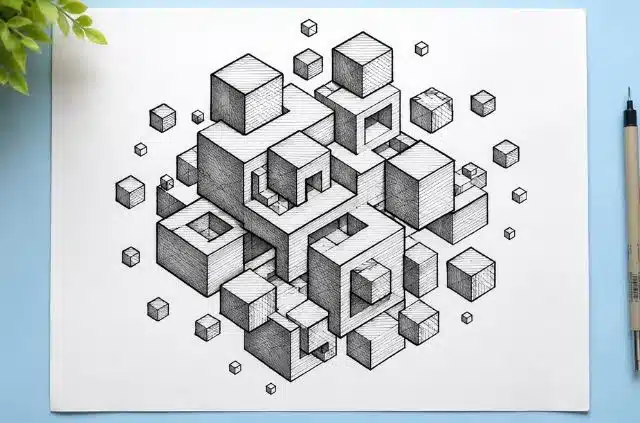
The classic 3D cube is one of the easiest places to begin.
Start by drawing a small square. Add another square slightly offset from the first, then connect the matching corners with straight lines.
Once the basic shape works, add parallel lines inside the cube or shade one side.
The important thing is consistency. If one side follows a particular angle, try to keep the other sides moving in the same direction.
2. Tunnel of Squares
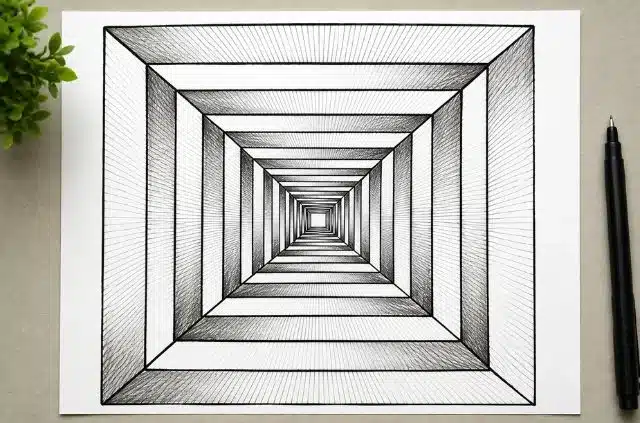
This one looks much harder than it is.
Draw a large square. Inside it, draw another slightly smaller square. Keep repeating the process toward the centre.
Now connect selected corners between the squares.
The repeated lines create the impression that you’re looking down into a deep tunnel.
Try making the centre very small. The deeper it becomes, the stronger the illusion can feel.
3. Impossible Triangle
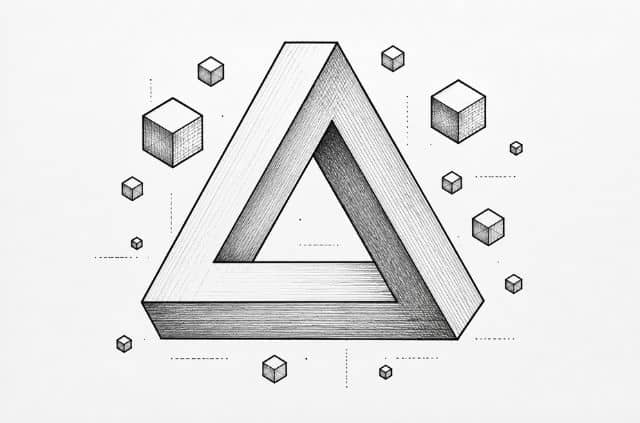
An impossible triangle, often called a Penrose triangle, is a brilliant introduction to optical illusions.
The basic idea is to make three sections appear to connect in a way that could not physically exist as a solid object.
Begin with three angular sections. Carefully connect them so that each part seems to pass behind or in front of another.
This one takes patience.
If the first attempt looks confusing, that’s normal. The drawing itself is supposed to confuse the eye.
4. Wavy Grid
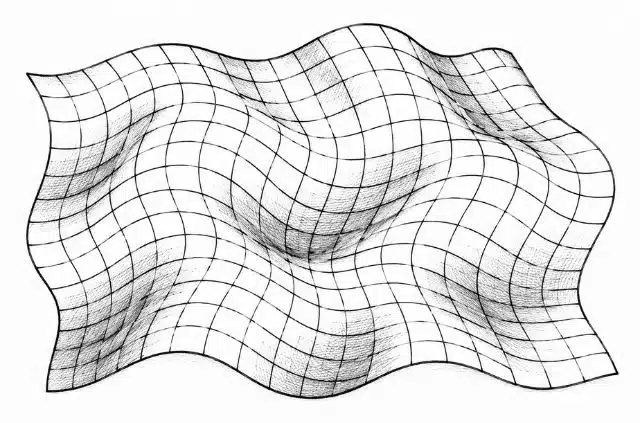
A straight grid can become surprisingly strange when you bend the lines.
Draw several horizontal lines and several vertical lines. Instead of keeping them perfectly straight, gently curve them.
Make the lines bulge outward around the centre.
Suddenly, your flat grid can look like a rounded surface or a piece of fabric stretched over a ball.
For beginners, this is one of the easiest illusion doodles to practise because you don’t need perfect perspective.
5. 3D Hole Doodle
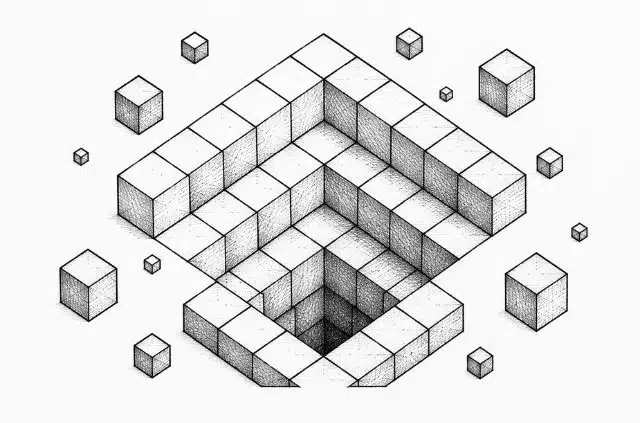
Want your page to look like it has a hole in it?
Start with a rough circular shape.
Inside the circle, draw smaller curved shapes following the same general outline. Make the inner lines darker and gradually reduce their size toward the centre.
Add heavier shading around one edge.
The contrast between light and dark gives the drawing more depth.
6. Spiral Tunnel
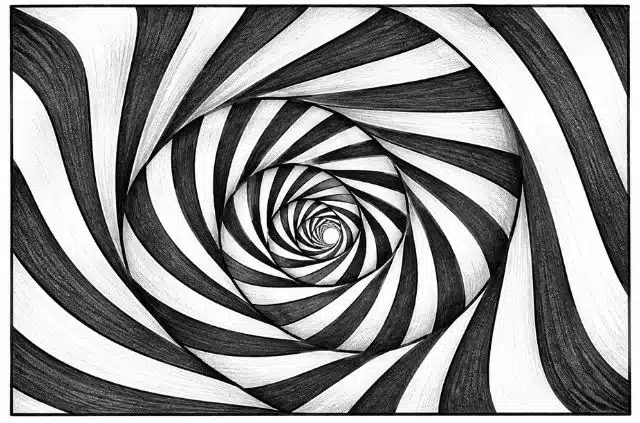
Draw a large spiral and gradually work your way toward the centre.
Then add another line beside the spiral so that it becomes a thick ribbon rather than one thin line.
Shade alternate sections.
The result can look like a twisting tunnel.
Don’t worry about making the spiral mathematically perfect. A slightly uneven hand-drawn spiral often looks more interesting.
7. Floating Circles
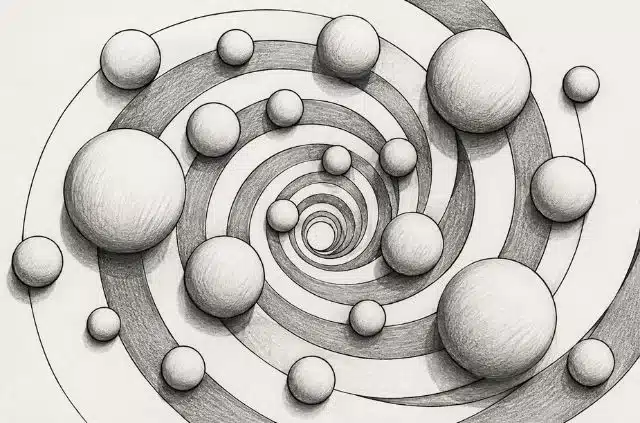
Draw several circles across the page.
Now give each circle a curved inner line that follows its shape. Add a darker section along one edge and a lighter section on the opposite side.
With enough shading, the circles can start looking like little balls floating above the paper.
You can make them overlap too. When one circle partially covers another, the sense of depth becomes stronger.
8. 3D Stairs
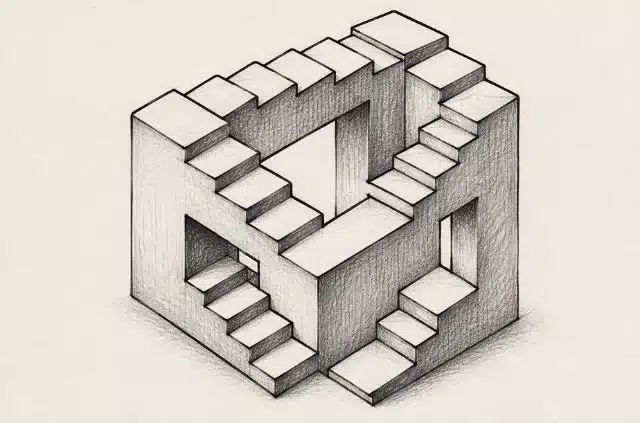
Draw a series of connected rectangles that gradually move upward or downward.
The trick is to keep the lines that represent each step moving in the same direction.
Add darker shading underneath each step.
From a distance, the flat drawing can start to look like an actual staircase.
Try drawing the staircase toward the centre of the page rather than straight across it for a stronger illusion.
9. Impossible Staircase
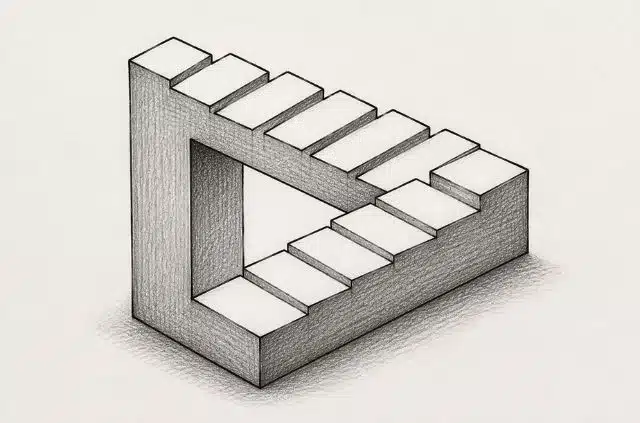
Once you’ve mastered the basic staircase, make it impossible.
Instead of allowing the stairs to reach a normal endpoint, connect the sections so that they appear to continue around in a loop.
The viewer’s brain expects the staircase to have a beginning and an end.
When those points don’t make sense, the illusion becomes much more noticeable.
10. 3D Letter Doodles
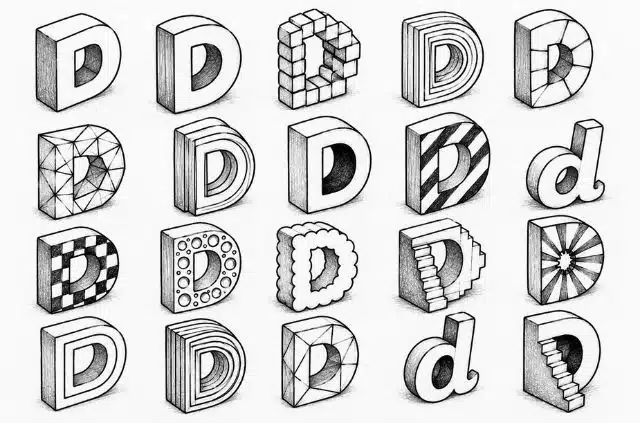
Letters can become surprisingly good illusion drawings.
Choose a simple letter such as:
- A
- B
- E
- M
- S
- T
Draw the letter with thick outlines and then add depth lines behind it.
You can make the letter look like it is floating, sinking into the page, or extending outward.
Try your own initials for a more personal version.
11. Twisted Ribbon
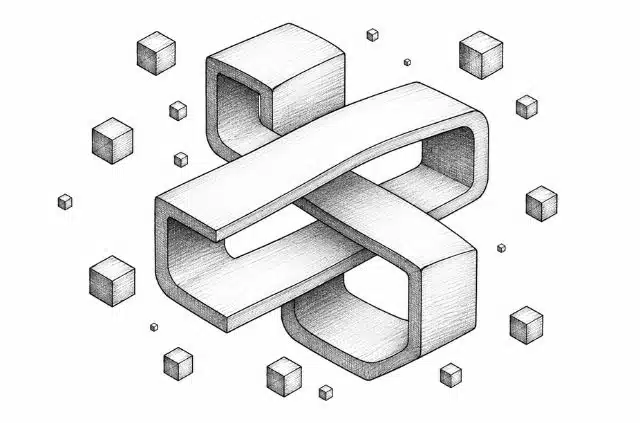
Start with two long curved lines that run beside one another.
Cross them over each other several times.
At every crossing point, decide which section is in front and which is behind. Then erase or avoid the lines that should be hidden.
Add small areas of shading underneath the overlapping sections.
This makes the ribbon appear to twist around itself.
12. Optical Flower
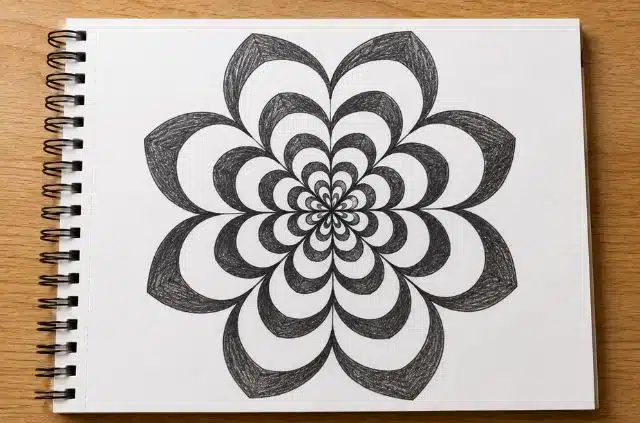
Start with a simple flower shape.
Instead of leaving the petals flat, fill each petal with curved lines that follow its shape.
Then gradually change the direction of the lines as they approach the centre.
A little shading around the petal edges can make the flower look almost inflated.
If you enjoy botanical doodles, you can combine this technique with these easy flower doodles or experiment with plant doodles.
13. 3D Heart
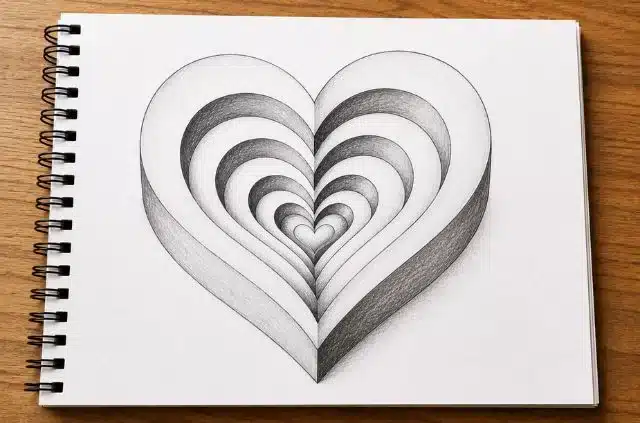
Draw a heart outline.
Inside it, add several smaller heart shapes, following the same curves.
The inner hearts should gradually become smaller.
Shade one side of the spaces between them.
The result can look like a heart-shaped tunnel.
You can also turn the heart into a Valentine’s Day or love-themed doodle by adding tiny stars, flowers, or ribbons around it.
14. Optical Eye Doodle
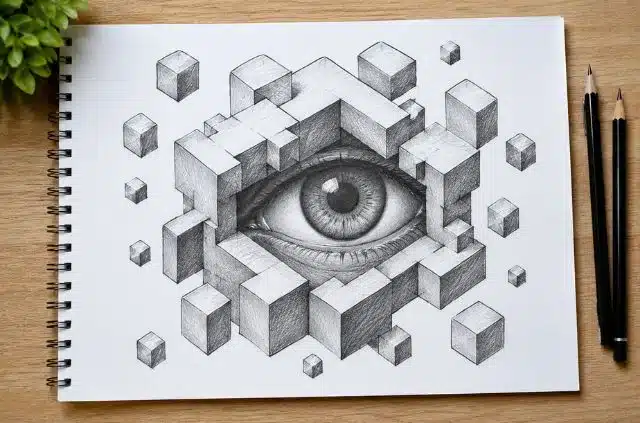
Eyes are naturally interesting to draw because they already contain layers of curved shapes.
Start with an almond-shaped eye.
Add the iris, pupil, and several curved lines around the iris.
Now use repeated curved strokes to create the illusion that the eye is surrounded by a swirling pattern.
The trick is to follow the shape of the eye rather than filling the area with random lines.
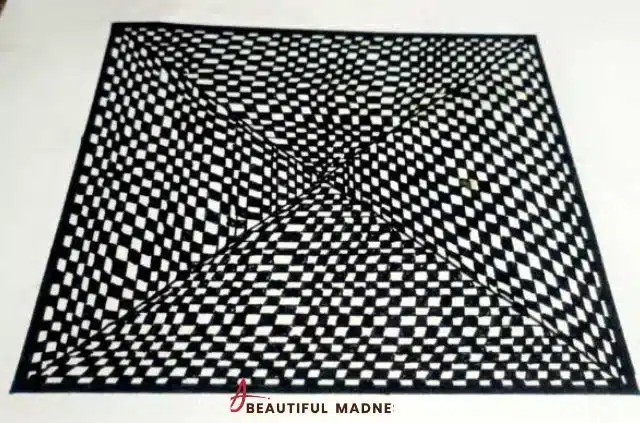
15. Checkerboard Illusion
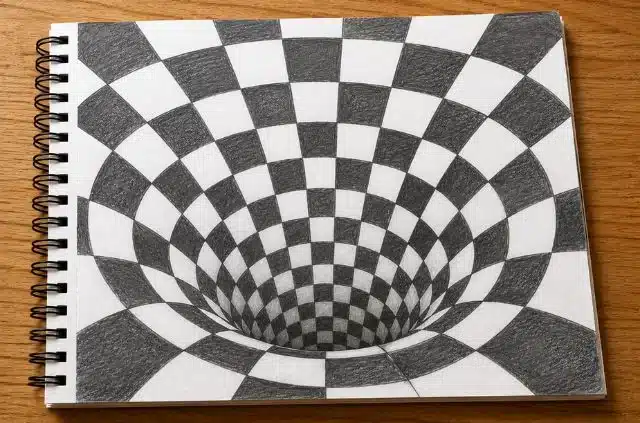
Draw a checkerboard pattern using alternating squares.
Then gradually change the size or angle of the squares toward the centre.
You can make one area appear to sink into the page while another seems to rise.
This is a good exercise for learning how spacing affects the way we perceive depth.
16. 3D Sphere
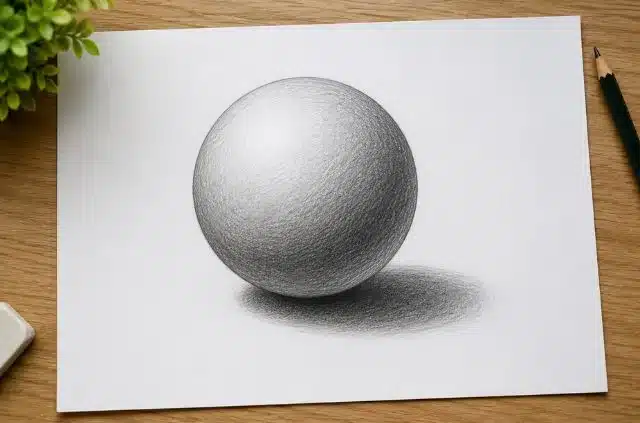
A sphere is a great shading exercise.
Begin with a circle.
Draw several curved lines inside it, following the roundness of the shape. Keep the lines closer together on one side and more spread out on the other.
Shade the darker side.
Add a tiny white highlight if you’re using coloured pencils or leaving areas of the paper untouched.
The circle should begin to feel round rather than flat.
17. Doodle Maze
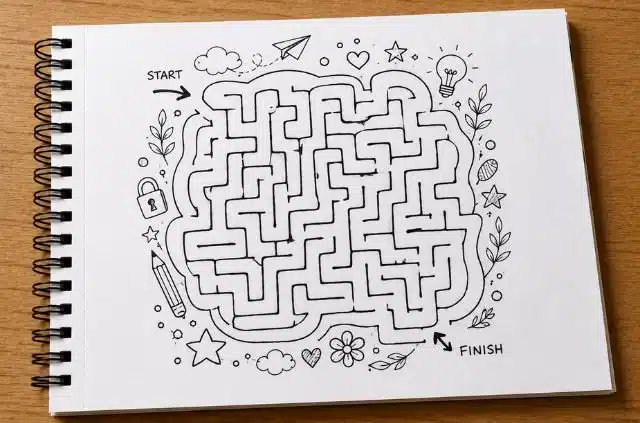
Create a maze using thick, winding lines.
Instead of making every path straight, curve some of the passages and create false openings.
You can add arrows, dots, tiny stars, or miniature shapes along the path.
This is particularly fun when you start with a simple maze and gradually make it more complicated.
18. Falling Blocks
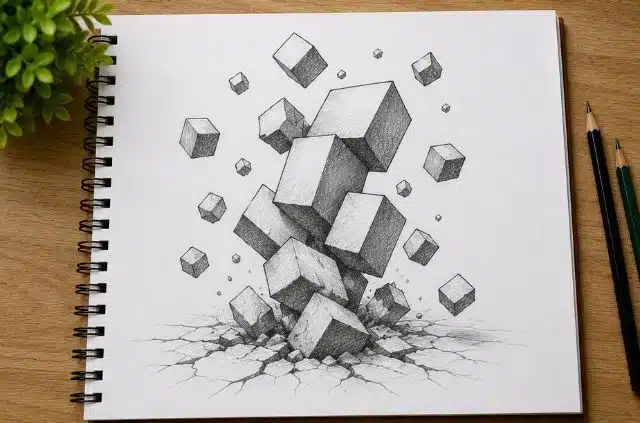
Draw several cubes as though they are falling through the page.
Make the blocks different sizes.
The largest blocks should appear closer, while the smaller ones can appear farther away.
Add shadows beneath some of them.
The combination of size, spacing, and shading creates the illusion of distance.
19. Optical Waves
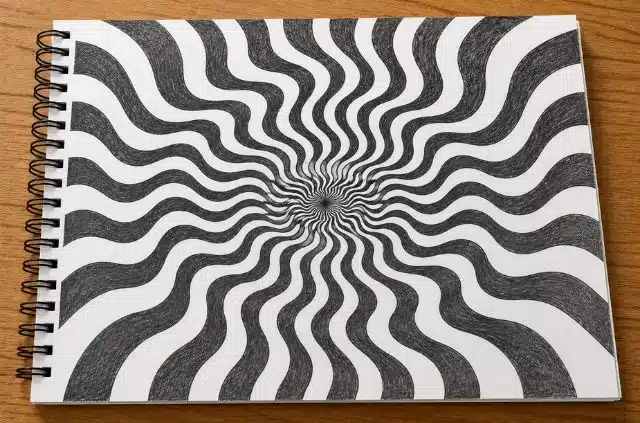
Draw several long horizontal lines.
Slowly curve them upward in one area and downward in another.
Repeat the pattern until the page is filled.
The lines can look like waves moving across the paper.
Add small circles or dots between some of the lines to exaggerate the effect.
20. Hidden Shape Doodle
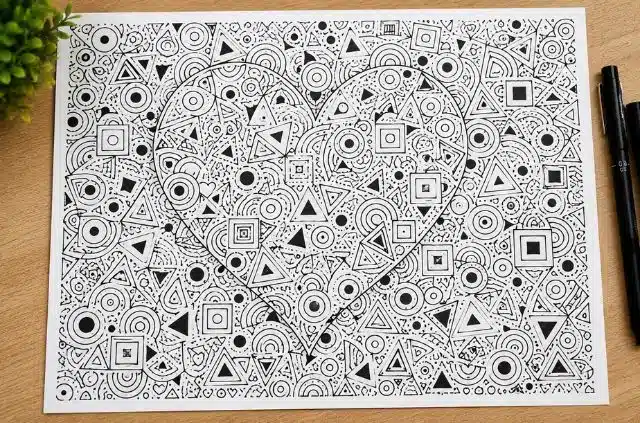
Create a busy pattern using circles, triangles, squares, and curved lines.
Then hide one larger shape inside the pattern.
For example, you could hide a:
- heart
- star
- cat
- flower
- letter
- moon
The challenge is making the hidden shape noticeable only after someone looks closely.
This idea works particularly well when you want something more playful rather than a traditional 3D illusion.
How to Make Illusion Doodles Look Better
The good news is that you don’t need perfect drawing skills.
What matters more is understanding a few basic techniques.
The basics of how to draw doodles are useful here too. Simple shapes, controlled lines, and a little repetition are all you need before adding perspective, shading, and depth.
Use Repetition
Repetition is one of the easiest ways to create visual depth.
Draw the same shape several times while gradually changing its size.
For example:
Large square → medium square → smaller square → tiny square.
Your eye naturally starts reading the sequence as movement toward or away from you.
Keep Your Lines Consistent
If you’re drawing a 3D cube, don’t randomly change the direction of your perspective lines.
If three lines are supposed to move upward at the same angle, keep them roughly parallel.
You don’t need ruler-perfect precision, but consistency helps the illusion work.
Experiment With Shading
Shading can completely change a doodle.
You can use:
- cross-hatching
- dots
- short strokes
- solid black areas
- gradual pencil shading
A simple rule is to choose one imaginary light source.
If the light comes from the upper left, the lower-right areas can be darker.
This gives the object a more believable sense of depth.
Play With Negative Space
Sometimes the empty part of the drawing is just as important as the lines.
Negative space is the area around and between the objects you’re drawing.
You can use it to create hidden images, gaps, holes, and impossible shapes.
This is especially useful for optical illusion doodles because the eye constantly switches between the drawn object and the space surrounding it.
Start With Pencil
Don’t immediately reach for your darkest pen.
Use a pencil first to work out:
- proportions
- perspective
- overlaps
- spacing
- shading
Once you’re happy with the structure, trace the strongest lines with a fineliner.
This makes experimenting much less stressful.
Add Patterns Carefully
Patterns can make illusion drawings much more interesting, but too many patterns can destroy the effect.
If you’re interested in more structured repetitive drawing, Zendoodle patterns are useful inspiration because they show how repeated lines and shapes can build visual complexity.
The trick is knowing when to stop.
Sometimes one simple curved line does more than twenty decorative ones.
Turn Simple Doodles Into Illusions
You don’t always need to start with an optical illusion.
Take an ordinary doodle and ask:
Can I make this look deeper?
A flower can become a 3D flower.
A heart can become a tunnel.
A cat can appear to jump out of the page.
A circle can become a sphere.
A simple pattern can become a maze.
That is where illusion doodling becomes really fun.
For example, if you enjoy drawing animals, try turning a simple cat doodle into a 3D character by adding thick outlines and shadows.
You can do the same with a bunny using these bunny doodle ideas.
Make Your Illusion Doodles More Personal
The easiest way to make a doodle feel less generic is to stop worrying about making it perfect.
Your drawing doesn’t need to look like it came from a geometry textbook.
In fact, slightly uneven lines can give it personality.
Mix Illusion Techniques With Everyday Objects
Try taking something ordinary and giving it an impossible twist.
A coffee cup could look like it is floating.
A book could appear to have a tunnel through its pages.
A backpack could look like it is opening into another dimension.
A breakfast plate could become a miniature 3D scene.
If you enjoy drawing familiar objects, these breakfast doodle ideas can provide simple subjects to transform into illusion drawings.
You can even take ideas from easy drawing ideas and add perspective, shadows, or repeating lines to turn them into something more unusual.
Try Silly Illusion Doodles
Not every illusion needs to be serious.
Draw a tiny character falling into a giant hole.
Make a cartoon face appear through a 3D wall.
Draw a little snail crawling along an impossible staircase.
Or make an object appear to break through the edge of the page.
If you like playful drawings, silly doodles are a good reminder that doodling doesn’t have to follow strict artistic rules.
Make Doodling Part of Your Notes
Illusion doodles don’t have to exist separately from everyday writing.
You can use tiny 3D arrows, boxes, banners, stars, and symbols in notebooks.
For example, a heading could have a small 3D shadow underneath it, or a word could look as though it is popping out from the page.
This can make ordinary notes more visually interesting without turning the entire page into artwork. For more ideas, see doodle notes.
Use Illusion Doodles When You’re Bored
Sometimes the best drawings happen when you’re not trying too hard.
If you’re sitting through a long lecture, waiting for an appointment, or simply staring at a blank page, start with one small shape.
A square.
A circle.
A spiral.
Then ask yourself:
What happens if I keep repeating it?
That’s often enough to begin.
If you want more simple ideas for those moments, these easy doodles to draw when bored in class can help you keep your hands busy without needing complicated supplies.
Try Mindful Illusion Drawing
Illusion doodling can also become a slow, repetitive drawing activity.
Instead of worrying about the finished image, concentrate on each line as you draw it.
Notice the pressure of the pencil.
Notice how the pattern changes.
Notice where your hand naturally wants to move.
This approach connects nicely with mindful doodling and other mindfulness art activities.
You don’t have to create a masterpiece.
Sometimes ten quiet minutes of drawing is enough.
Let Kids Experiment With Optical Doodles
Children don’t need to understand perspective terminology to enjoy illusion art.
Give them paper, pencils, crayons, or markers and let them experiment with:
- repeating shapes
- spirals
- hidden pictures
- 3D blocks
- curved grids
- impossible objects
- colourful patterns
The goal isn’t technical perfection.
It’s curiosity.
For age-appropriate creative activities, you can also explore these kids’ art activities.
Common Mistakes Beginners Make With Illusion Doodles
Trying to Make Everything Perfect
A crooked line doesn’t automatically ruin a doodle.
If you’re drawing by hand, tiny imperfections are expected.
Adding Too Much Detail Too Early
Start with the structure.
Once the illusion works, add decorations.
If you begin with dozens of patterns, it becomes difficult to tell which lines are actually creating the illusion.
Forgetting Light and Shadow
If every part of a 3D drawing has exactly the same darkness, it can look flat.
Even a little contrast can make a major difference.
Changing Perspective Halfway Through
This is particularly common with cubes and staircases.
Choose the direction of your perspective lines before adding lots of details.
Giving Up After One Attempt
Some illusion drawings look strange halfway through.
That’s normal.
Keep going until the major lines are complete. You may be surprised by how different the finished drawing looks from the messy middle stage.
Simple Illusion Doodle Practice Exercise
If you want to improve quickly, don’t try twenty complicated drawings in one sitting.
Pick one basic shape.
Step 1: Draw a Circle
Keep it simple.
Step 2: Add Repeated Curves
Follow the shape of the circle.
Step 3: Change the Spacing
Make some lines closer together and others farther apart.
Step 4: Add Shading
Choose one side as the darker side.
Step 5: Add a Shadow
A small shadow underneath can make the object appear to lift from the page.
Step 6: Experiment
Now try the same technique with a square, heart, star, or letter.
This is how a simple doodle becomes a personal drawing style.
What Makes a Doodle Feel Human?
There’s something worth remembering when creating or writing about doodle art: perfect doesn’t always mean better.
A drawing can have uneven lines and still be beautiful.
The same applies to the way we describe art.
Human writing tends to include little observations, varied sentence lengths, questions, humour, preferences, and moments of uncertainty. It doesn’t constantly sound like a textbook.
Compare these two descriptions:
Robotic:
Illusion doodling is an artistic activity that promotes creativity and provides individuals with an opportunity to explore visual perception.
More natural:
The funny thing about illusion doodles is that they can look impossible even though you made them with a few ordinary lines. You start with a square, add a couple of shadows, and suddenly your flat notebook page looks like it has a hole in it.
The second version feels more like someone talking to another person.
That’s useful when writing about creative subjects because readers usually aren’t looking for a formal lecture. They want ideas they can actually try.
Keep Sentence Lengths Varied
Short sentences work.
So do longer ones.
Mix them.
Instead of writing every paragraph in the same rhythm, let the writing breathe.
For example:
Draw the circle first.
Then add another one inside it.
Keep going until the centre becomes tiny, and suddenly the page starts looking like a tunnel.
That feels more natural than explaining every step in the same formal sentence structure.
Avoid Repeating the Same Keyword
You don’t need to say illusion doodle art in every paragraph.
Use natural variations such as:
- illusion doodles
- optical doodles
- 3D doodles
- illusion drawings
- optical illusion art
- doodle patterns
- 3D drawing ideas
- perspective doodles
Search engines and AI systems can understand that these ideas belong to the same topic.
More importantly, your reader won’t feel like they’re being followed around by the same keyword.
Frequently Asked Questions About Illusion Doodle Art
Illusion doodle art is drawing that uses lines, patterns, perspective, shading, repetition, and overlapping shapes to create the appearance of depth, movement, or impossible objects on a flat surface.
Yes. Beginners can start with simple techniques such as repeating squares, curved grids, 3D cubes, spirals, spheres, and tunnels. More complicated optical illusions can be attempted once the basic techniques feel comfortable.
A pencil, eraser, paper, and black pen are enough. A ruler can help with geometric drawings, while coloured pencils or markers can be used to add contrast and visual interest.
Use consistent perspective lines, overlapping shapes, gradual changes in size, and light-and-dark shading. Repeating a shape while making it progressively smaller can also create the appearance of depth.
A tunnel made from repeated squares, a wavy grid, a spiral tunnel, or a simple 3D cube are good starting points because they rely on basic shapes rather than advanced drawing skills.
Absolutely. Simple optical patterns, repeating shapes, 3D blocks, spirals, and hidden-picture drawings can all be adapted for children. The activity can focus on experimentation rather than perfect perspective.
Not exactly. Doodling is a broad form of spontaneous or casual drawing, while illusion drawing deliberately uses visual techniques to create a particular effect. An illusion drawing can still be a doodle when it is created casually rather than as formal artwork. The work of some famous doodle artists crosses this boundary by combining freehand marks with structured patterns, perspective and intricate visual effects.
Part of the appeal comes from watching a simple collection of lines suddenly become something that appears three-dimensional or impossible. There is also a small sense of discovery: the drawing looks flat while you’re making it, then your eyes suddenly read it differently.
Final Thought
Illusion doodle art sounds complicated until you actually put a pencil on paper.
Start with a square.
Make another square inside it.
Add a few connecting lines.
Shade one side.
Suddenly, you’ve got a tunnel.
That’s really the secret. You don’t need to begin with an impressive optical illusion. Start with ordinary shapes and experiment with what happens when you repeat, bend, overlap, shrink, stretch, or shade them.
Some drawings will work beautifully.
Some will look completely ridiculous.
Keep the ridiculous ones too.
They usually make the best practice.