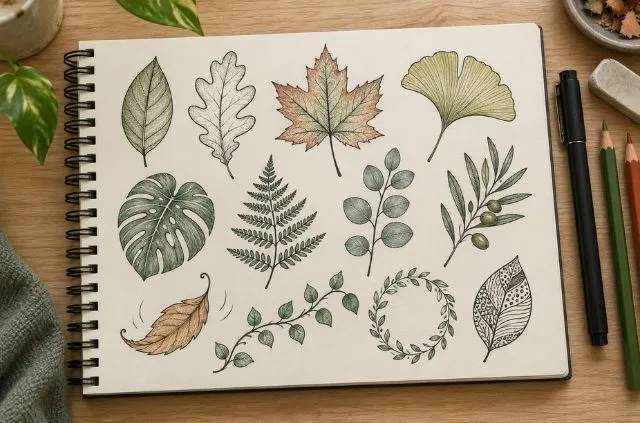
A leaf doodle is one of the easiest ways to add a little nature to a blank page. It can be as simple as an oval with a line through the middle, or as detailed as a curled autumn leaf filled with tiny patterns.
Leaves are especially good for beginners because there is no single “correct” shape. Some are long and narrow, some are round, and others have jagged or deeply cut edges. A slightly uneven line can make a leaf look more natural rather than less polished.
In this guide, you will learn how to draw a basic leaf doodle step by step. You will also find 35 easy ideas for sketchbooks, bullet journals, cards, class notes and quiet drawing time.
What Is a Leaf Doodle?
A leaf doodle is a small, informal drawing based on the shape, veins or growth pattern of a leaf. Most leaf doodles use a few quick lines and do not aim for botanical accuracy.
That freedom is part of what makes a doodle different from a formal drawing. You can draw from a real leaf, work from memory or invent a leaf that could never grow in nature. The result may be realistic, decorative, cute or completely abstract.
Leaf doodles can be used on their own or combined to make:
- notebook corner decorations;
- bullet journal dividers;
- borders and wreaths;
- greeting cards and gift tags;
- repeating patterns;
- nature study pages;
- mindful drawing exercises; and
- small illustrations beside handwritten notes.
What You Need
You only need paper and a pencil or pen. A simple HB pencil is helpful if you want to erase the first outline, while a black fineliner gives the finished doodle a clean look.
You may also like to use:
- an eraser;
- coloured pencils;
- brush pens;
- water-based markers;
- a white gel pen for highlights; or
- a sketchbook or dot-grid journal.
Avoid worrying about specialist supplies. Learning how to draw doodles is mostly about becoming comfortable with simple shapes and repeated marks.
How to Draw a Simple Leaf Doodle Step by Step
Step 1: Draw the centre stem
Draw one short line that curves gently upwards. This will become the main vein and the small stem at the bottom of the leaf.
Keep your hand relaxed. A natural curve usually looks softer than a perfectly straight line.
Step 2: Add one side of the leaf
Start near the bottom of the stem and draw a curved line outwards. Bring it back in until it meets the top of the centre line.
Think of this side as half of a long almond shape.
Step 3: Complete the outline
Repeat the curve on the other side. The two halves do not need to match exactly. Small differences can give the leaf a more organic appearance.
Step 4: Draw the veins
Add several short diagonal lines from the centre vein towards the outer edge. Space them loosely rather than measuring them.
For a softer design, stop each vein before it reaches the outline. For a bolder, more graphic leaf, let the veins touch the edge.
Step 5: Add colour or texture
Leave the doodle as simple line art, shade one side or fill it with colour. Tiny dots, parallel lines, checks and curved stripes can turn the same outline into a decorative pattern.
If the first leaf feels awkward, draw it three more times. Repetition is useful because your hand quickly becomes familiar with the shape.
35 Easy Leaf Doodle Ideas
1. Classic oval leaf
Draw a slim oval with pointed ends, then add a central vein and small diagonal veins. This is the easiest all-purpose leaf shape and a useful place to begin.
2. Tiny round leaf
Make a small circle or soft oval attached to a short stem. Leave it plain for a minimal icon or add one fine line through the centre.
3. Long narrow leaf
Draw two long curves that meet at a sharp point. This simple shape can resemble a willow, grass blade or olive leaf, depending on its width.
4. Heart-shaped leaf
Begin with a shallow dip at the top, widen both sides and finish at a point. Add a stem from the dip and curve the veins towards the edges.
5. Wavy-edged leaf
Replace the smooth outer curves with loose waves. Keep the centre line simple so the page does not become too busy.
6. Serrated leaf
Use small zigzags around the edge to suggest tiny teeth. Draw the basic silhouette lightly in pencil first if you find the pointed edge difficult to control.
7. Oak-style leaf
Create several rounded lobes on both sides of a central stem. The lobes can be uneven; that irregularity helps the doodle feel natural.
8. Maple-style leaf
Build the outline from five large pointed sections, with the tallest point in the centre. Add veins that spread out like the fingers of a hand.
9. Ginkgo fan leaf
Draw a thin stem and a wide fan shape at the top. Add a gentle notch in the centre and several fine lines spreading towards the curved edge.
10. Monstera leaf
Start with a large heart-like shape. Cut a few curved gaps into the sides and add oval holes inside. This tropical form also fits naturally among larger collections of plant doodles.
11. Eucalyptus sprig
Draw a gently bending stem, then place small round leaves alternately along it. Let a few leaves overlap the stem for a fuller look.
12. Olive branch
Use a long curved branch with pairs of narrow leaves. Add two or three small ovals as olives if you want more detail.
13. Fern frond
Draw one tall curved line, then add many slim leaflets that become smaller near the tip. It looks detailed, but it is only one repeated shape.
14. Clover leaf
Join three small heart shapes at the same centre point. Add a curved stem below; a fourth heart can turn it into a lucky four-leaf clover.
15. Herb leaf
Sketch a small pointed leaf with a softly toothed edge. Group several around a stem to suggest mint, basil or another garden herb without needing strict botanical detail.
16. Curled leaf
Draw the tip folding back over the main shape. A short inner curve and a little shading beneath the fold will create the illusion of depth.
17. Falling leaf
Tilt a small leaf diagonally and add two or three curved motion lines behind it. Draw several at different angles to create a breezy autumn scene.
18. Autumn leaf
Use an oak or maple-inspired outline and colour it with warm yellow, orange, rust and red. Leave small gaps between colours for a loose sketchbook effect.
19. Frosty winter leaf
Draw a bare or curled leaf with tiny crystals along the edge. Pale blue shading and a few white highlights can suggest frost.
20. Fresh spring leaf
Make a small leaf just beginning to open beside a bud. Light green colour and a thin outline will keep it looking delicate.
21. Leaf with a ladybird
Add a tiny half-circle or oval sitting on the leaf. Divide its back down the middle and use a few dots to make the insect recognisable.
22. Leaf with a raindrop
Place one large teardrop and a few smaller droplets on the surface. A tiny uncoloured patch inside each drop can act as a highlight.
23. Smiling leaf character
Give a simple leaf two dot eyes, a curved smile and tiny stick arms. Change the expression to make a happy, sleepy or surprised leaf.
24. Leaf in a plant pot
Draw one oversized leaf growing from a tiny pot. The contrast in size makes the design playful and easy to recognise.
25. Leaf and flower pair
Place two leaves beside a simple daisy, tulip or five-petal bloom. If you want to build a full botanical page, these easy flower doodles use the same beginner-friendly shapes.
26. Leaf wreath
Lightly draw a circle, then place small leaves around it in one direction. Erase the guide line after inking the leaves and leave the centre open for a date, initial or short word.
27. Leafy corner
Draw two stems growing inwards from the corner of a page. Add leaves of different sizes while keeping the middle area clear for writing.
28. Leaf border
Create one long stem along the top, bottom or side of a page. Alternate the leaves and vary their angles. It makes a useful divider among other bullet journal doodle ideas.
29. Hanging vine
Draw a loose vertical curve and attach heart-shaped or oval leaves at intervals. Add a second shorter vine so the design does not look too symmetrical.
30. Leaf garland
Use a curved string as your guide and hang small leaves from it. Alternate plain and patterned leaves to make the garland more decorative.
31. Leaf line drawing
Try to draw a stem and all its leaves without lifting your pen. The overlaps and imperfect connections become part of the design. Similar continuous techniques appear in flower line drawing ideas.
32. Leaf silhouette
Draw a clear outline and fill the whole shape with black ink or one solid colour. Place several different silhouettes together to compare their forms.
33. Pattern-filled leaf
Divide a large leaf into sections and fill each area with dots, waves, stripes, loops or checks. Repetitive marks work well for mindful doodling because the process can be slow and absorbing without requiring a perfect result.
34. Geometric leaf
Construct the outline from straight lines, then fill it with triangles or diamond shapes. This gives an ordinary nature subject a crisp, modern appearance.
35. Leaf mandala
Arrange small leaves in rings around a centre point. Begin with four leaves, place another four between them and continue outwards. Keep the shapes simple so the overall pattern remains clear.
Easy Leaf Patterns to Try
Once you can draw one leaf, you can turn it into a complete pattern. Repetition also removes the pressure to make every shape perfect; the eye sees the whole design rather than one uneven line.
Try one of these arrangements:
- rows of tiny leaves facing alternate directions;
- overlapping leaves in different sizes;
- a circle of leaves with their tips pointing outwards;
- scattered autumn leaves with small dots between them;
- vines crossing diagonally over the page;
- black leaf silhouettes mixed with outlines; or
- one large leaf filled with miniature leaves.
These designs can become notebook covers, wrapping-paper ideas or backgrounds for handmade cards. More abstract line doodle ideas can also be mixed into the empty spaces between leaves.
How to Make Your Leaf Doodles Look Better
Vary the size
Use one or two larger leaves as focal points, then add smaller shapes around them. A page filled with leaves of exactly the same size can feel flat unless you are deliberately making a repeating pattern.
Change the direction
Tilt leaves left and right instead of keeping every stem vertical. Curved stems and overlapping shapes help a group of leaves feel as though it is growing.
Use line weight
Trace the outer edge with a slightly thicker line and keep the veins thin. This small contrast can make the doodle clearer without adding more detail.
Leave breathing room
You do not need to fill every gap. Blank space around a leaf makes its silhouette easier to see, particularly on a journal page that also contains writing.
Look at real leaves
Notice where the leaf is widest, how the veins branch and whether its edge is smooth, wavy or toothed. You can simplify those observations rather than copying every detail.
Artists often develop a recognisable visual language by repeatedly simplifying what they see. Looking at the work and methods of famous doodle artists can show how repeated lines, shapes and motifs become part of an individual style without needing to copy anyone’s artwork.
Common Leaf Doodle Mistakes
Trying to make both sides identical
Real leaves are not perfectly mirrored. Instead of repeatedly erasing a small difference, keep it and see whether it adds character.
Adding every vein
Too many dark veins can overwhelm a small doodle. Three or four on each side are often enough to communicate the idea.
Pressing too hard at the start
Use light pencil pressure while exploring a shape. Dark marks are more difficult to erase and can make you feel committed to an outline too early.
Using only one leaf shape
Mixing round, narrow, lobed and heart-shaped leaves creates variety. A collection of cool doodle ideas can help you combine natural motifs with stars, clouds, lettering and small characters.
Judging quick sketches too harshly
Doodles are allowed to be loose. Many people make them while listening, thinking or waiting, which helps explain why people doodle even when they are not trying to produce finished artwork.
Where Can You Use Leaf Doodles?
Leaf doodles work well anywhere a page needs a small natural detail. Add them beside headings, around a quote, across a calendar box or in the margin of class notes.
If you are looking for easy doodles to draw when bored in class, a single sprig is quiet, quick and easy to stop whenever you need to return your attention to the lesson. Keep classroom doodling small enough that it does not cover important notes.
You can also use leaf designs on:
- bookmarks;
- name cards;
- envelopes;
- gift labels;
- recipe pages;
- habit trackers;
- handmade invitations; and
- digital drawing practice sheets.
Frequently Asked Questions
A classic oval leaf is usually the easiest. Draw a curved centre line, add two outer curves that meet at the tip, then include a few short veins. The whole doodle can be completed with fewer than ten lines.
Beginners can build a leaf from simple shapes: one line for the stem, two curves for the outline and several short lines for the veins. Drawing lightly in pencil first makes it easier to adjust the width and point.
No. A leaf doodle may be realistic, stylised or imaginary. Clear features such as a stem, pointed outline or central vein are usually enough to make the subject recognisable.
Begin at the base, draw one outer edge to the tip, return down the other edge and continue into the stem. Loop back through the middle for the main vein, then add smaller veins as connected lines. The overlaps are part of the one-line style.
Greens suit fresh leaves, while yellow, orange, red and brown create an autumn palette. Blue, pink or purple can make the design feel playful. Black ink alone works especially well for minimal pages and pattern-filled leaves.
Start with three or four large leaves, add smaller sprigs in the gaps and turn some shapes in different directions. Finish with tiny dots, berries or curved lines, but leave a little open space so each design remains visible.
A Simple Leaf Is Enough to Begin
Start with one stem, two curves and a few veins. Once that shape feels comfortable, change the edge, length, colour or pattern. The same basic leaf can become a fern, wreath, vine, autumn motif or cheerful character.
There is no need to make each version perfect. A page of slightly different leaves often feels more lively than a row of identical ones—and every new shape gives you another small idea to use in future drawings.