Have you ever started drawing one little line on a blank page and somehow ended up filling half of it with swirls, waves, shapes, and strange little patterns?
That is the fun of a line doodle.
You do not need perfect drawing skills, expensive supplies, or even a plan. A pen and a piece of paper are enough to turn simple lines into patterns, flowers, faces, borders, abstract shapes, and surprisingly detailed drawings.
Line doodles are especially good for beginners because you can start with something as simple as a wavy line and slowly build from there. One curve becomes a leaf. A few loops become a flower. Repeated lines turn into a pattern.
And before you know it, the empty corner of the page is no longer empty.
In this guide, you will find line doodle ideas for beginners and experienced doodlers, simple ways to practise different lines, step-by-step ideas, pattern inspiration, and a few ways to take your doodling from basic marks to more detailed artwork.
What Is a Line Doodle?
A line doodle is a drawing created mainly with lines rather than detailed shading, realistic colouring, or complicated techniques.
The lines can be straight, curved, broken, wavy, spiralled, thick, thin, or repeated. You can keep them completely abstract or use them to create recognisable objects.
For example, a single curved line could become:
- A flower stem
- A vine
- A wave
- A cloud
- A snake
- A ribbon
- A face outline
- A decorative border
The interesting part is that there are no strict rules.
If you are completely new to doodling, it can help to first understand what a doodle actually is and how doodling differs from a traditional drawing. Doodling is usually spontaneous and does not require you to know exactly what you are going to create before your pen touches the paper.
That is also why line doodles can feel so relaxing.
You are not trying to produce a perfect illustration. You are simply letting one line lead to another.
Why Are Line Doodles So Easy to Start?
Traditional drawing can sometimes feel intimidating.
You look at a blank page and think, What am I supposed to draw?
With line doodles, you can forget that question.
Start with a dot.
Turn it into a line.
Add another line.
Repeat it.
That is enough.
The beauty of simple doodles is that even an imperfect line can become part of the design. A wobbly curve does not necessarily ruin the drawing. It can make the doodle feel more handmade.
Why Do People Doodle?
People doodle for all sorts of reasons.
Some doodle while talking on the phone. Others draw during meetings, when student bored in the classroom, waiting periods, or while listening to someone speak.
Sometimes the hand simply wants something to do.
Researcher Jackie Andrade is particularly well known for research into doodling and attention. Her work explored whether simple doodling could help people maintain attention during a monotonous task.
That does not mean every doodle automatically improves concentration. Context matters, and different kinds of drawing may affect attention differently.
There is also an interesting distinction between random doodling and drawing something connected to what you are learning. Research has explored how drawing information can sometimes support memory and understanding.
There is also an interesting distinction between random doodling and doodle notes or drawings connected to what you are learning. Research has explored how drawing information can sometimes support memory and understanding.
So the next time you fill the edge of your notebook with little lines, flowers, or geometric shapes, you may not simply be wasting time.
You might just be giving your hands something small to do while your mind keeps working.
Easy Line Doodle Ideas for Beginners
You do not need to begin with complicated artwork.
In fact, the best way to learn how to draw doodling is to practise simple lines first.
Here are some beginner-friendly ideas to try.
1. Wavy Lines
Draw a simple wave from left to right.
Now draw another underneath it.
Keep repeating the waves until you have a small pattern.
Try making each wave slightly different. Some can be wide and relaxed, while others can be narrow and tightly packed.
2. Spiral Doodles
Start with a small circle and slowly work your way outward.
Do not worry about making the spiral perfectly even.
Try filling a small square with several spirals. You can also place spirals inside flowers, leaves, clouds, and abstract shapes.
3. Looping Lines
Draw a long line that loops around itself.
You can make the loops:
- Large
- Tiny
- Rounded
- Pointed
- Overlapping
A page filled with looping lines can quickly become an interesting abstract doodle.
4. Zigzag Lines
Zigzags are one of the easiest doodle patterns to practise.
Draw several rows of triangles or lightning-bolt shapes.
Then experiment with spacing.
You can even combine zigzags with dots, circles, or short parallel lines.
5. Dotted Lines
A line does not always have to be continuous.
Try making a row of evenly spaced dots.
Then create another row underneath with the dots closer together.
Dotted lines work beautifully around flowers, lettering, borders, and geometric doodles.
6. Leaf Lines
Draw a long curved stem.
Add small pointed leaves along both sides.
Once you are comfortable with that shape, change the leaf sizes and directions.
You can turn a basic leaf doodle into a whole vine by simply repeating the same movement.
7. Flower Line Doodles
Start with a small circle.
Surround it with simple petals.
You can make round petals, pointed petals, heart-shaped petals, or long narrow petals.
Then add a curved stem underneath.
If you enjoy botanical drawings, you can experiment with more easy flower doodles by combining simple outlines with repeated patterns inside the petals.
8. Cloud Doodles
Draw several connected curves to create a cloud shape.
Inside it, add tiny lines, stars, raindrops, or swirls.
Clouds are especially useful when you want to decorate the corners of a notebook page.
9. Geometric Line Doodles
Use simple shapes such as:
- Circles
- Squares
- Triangles
- Diamonds
- Hexagons
Draw them separately first.
Then overlap them.
Add lines inside the shapes.
Soon you will have a geometric doodle that looks much more complicated than the individual parts.
10. Border Doodles
Take the edge of a notebook page and create a repeating pattern.
Try:
wave → dot → wave → dot
Or:
leaf → leaf → flower → leaf
Borders are a great way to practise repetition without having to fill an entire page.
How to Draw Line Doodles Step by Step
Once you have practised basic marks, you can start combining them.
The easiest way to improve is not to jump straight into complicated artwork. Build your doodle in layers.
Step 1: Start With One Basic Line
Pick one movement.
It could be a:
- Curve
- Wave
- Spiral
- Zigzag
- Loop
- Straight line
Draw it several times.
The goal is not perfection. You are simply getting comfortable with the movement.
Step 2: Repeat the Line
Now repeat it.
Make the lines close together in one section and farther apart in another.
Notice how spacing changes the appearance of the doodle.
This simple exercise teaches you an important part of doodling: repetition creates visual interest.
Step 3: Add a Second Pattern
Suppose you started with waves.
Add small dots between them.
Or place tiny circles inside the curves.
Or add short vertical lines.
You have now turned one basic line into a pattern.
Step 4: Create Sections
Draw a large circle or irregular shape.
Divide it into several sections using curved lines.
Fill each section with a different pattern.
For example:
- Section one: dots
- Section two: waves
- Section three: spirals
- Section four: leaves
- Section five: zigzags
This is a simple way to create detailed doodle art without needing advanced drawing skills.
Step 5: Experiment With Line Weight
If you are using a pen, try pressing slightly more firmly in some areas and lightly in others.
You can also use pens with different nib sizes.
A thicker outer line can make an object stand out, while thinner internal lines can add detail.
You do not need complicated shading to create contrast.
Sometimes changing the thickness of a line is enough.
Step 6: Add Small Details
This is where a simple doodle starts becoming your own.
Add:
- Tiny dots
- Short dashes
- Mini flowers
- Leaves
- Stars
- Circles
- Crosshatching
- Small geometric shapes
Do not add details everywhere.
Leaving some empty space can actually make the detailed parts look more interesting.
Step 7: Connect Everything
Look at the empty spaces between your patterns.
Could you connect two areas with a vine?
Could a curved line travel through the design?
Could a few dots fill an awkward gap?
This is where spontaneous doodling becomes especially fun.
You are no longer following a strict drawing tutorial. You are responding to what is already on the page.
From Beginner to Pro: A Simple Progression
If you want to move from beginner doodling towards more advanced line art, try this progression:
Beginner:
Single lines → waves → dots → circles → basic shapes
Intermediate:
Patterns → flowers → leaves → geometric designs → borders
Advanced:
Layered patterns → overlapping shapes → detailed line art → optical effects → complex compositions
You can also explore different types of doodle patterns and combine them rather than copying one design repeatedly.
That is often how a basic doodler develops a personal style.
Creative Line Doodle Ideas to Take Further
Once simple patterns feel comfortable, there is no reason to keep your doodles tiny.
Let the lines become part of something bigger.
1. Continuous-Line Doodles
Try drawing an object without lifting your pen from the paper.
Start with a simple object such as a:
- Face
- Flower
- Cat
- Hand
- Cup
- Plant
- Sun
The result does not need to look realistic.
The challenge is to see how far one continuous line can travel.
2. Line Art Faces
Start with a simple outline of a face.
Use one flowing line for the forehead, nose, lips, and chin.
Then add a few separate lines for the eyes or hair.
This can create surprisingly expressive line art doodles with very little detail.
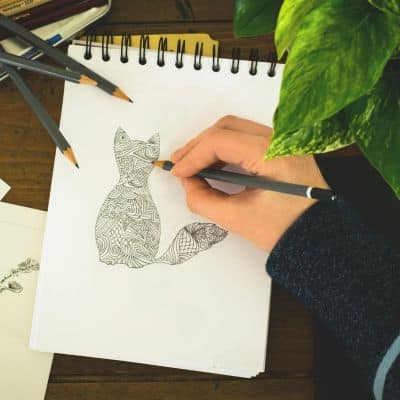
3. Pattern-Filled Shapes
Draw a large heart, star, moon, leaf, or circle.
Then fill the inside with different line patterns.
Try combining:
- Spirals
- Waves
- Dots
- Crossed lines
- Leaves
- Tiny circles
- Zigzags
- Zendoodle Pattern
The outer shape remains simple while the inside becomes detailed.
4. Doodle Landscapes
Use lines to create a tiny landscape.
A few curved lines can become hills.
Vertical lines can become trees.
Wavy lines can represent water.
Add clouds, birds, flowers, and a sun.
You do not need realistic perspective. The goal is to create a small world from simple marks.
5. Optical Line Doodles
Line doodles can also create the illusion of movement or depth.
Try drawing:
- Repeating waves
- Concentric circles
- Curved grids
- 3D cubes
- Tunnels
- Spirals
- Overlapping geometric shapes
Start with a simple shape and repeat it at slightly different sizes.
The closer the shapes become, the more interesting the illusion can feel.
6. Botanical Line Doodles
Plants are almost perfect for line doodling.
Start with one stem.
Add leaves.
Then add smaller stems.
From there, you can build vines, flowers, mushrooms, branches, or little garden scenes.
The same basic curved line can be used again and again, but small changes in shape keep the drawing from looking repetitive.
7. Cute Line Doodles
If you prefer playful drawings, turn simple shapes into characters.
A circle can become a face.
Two dots can become eyes.
A curved line can become a smile.
Add tiny arms and legs and suddenly you have a little character.
Try creating:
- Sleeping faces
- Tiny ghosts
- Mushrooms
- Cats
- Bears
- Stars with faces
- Little plants
- Smiling clouds
Cute doodles are especially easy to customise because even a few lines can give a character personality.
8. Mindful Line Doodling
Line doodling can also be used as a slow, relaxing creative activity.
Instead of worrying about what the finished picture should look like, focus on the movement of the pen.
Draw one line.
Repeat it.
Change direction.
Add another pattern.
Let the page develop gradually.
This kind of mindful doodling can be less about producing impressive artwork and more about giving yourself a quiet creative moment.
There is something oddly satisfying about watching a blank page slowly disappear under a collection of tiny marks.
9. Doodles for Kids
Line doodles are not only for adults.
Kids can begin with simple shapes, dots, waves, spirals, flowers, animals, and faces.
Give them a blank sheet and ask them to turn five random lines into a picture.
There is no right answer.
One child might see a snake.
Another might see a flower.
Someone else might turn the same lines into a funny monster.
That freedom is part of the appeal of kids’ art activities.
10. Make Your Own Line Doodle Style
Eventually, stop copying.
Take the patterns you enjoy most and combine them.
Maybe you like botanical shapes with geometric patterns.
Or cute faces surrounded by spirals.
Or abstract lines mixed with flowers.
Or black-and-white patterns with very thick outlines.
Your style does not need a fancy name.
If you repeatedly make certain choices, a style will naturally start appearing in your work. This gradual development can be seen in the work of famous doodle artists, whose recurring choices in line weight, patterns, characters and composition make their individual styles recognisable.
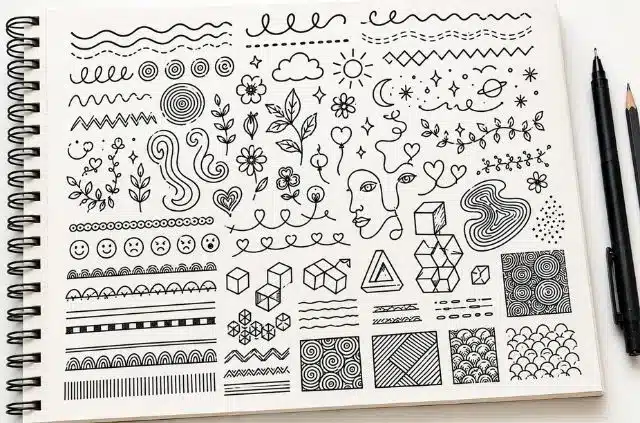
A Simple Line Doodle Practice Page
If you are not sure what to draw today, divide a page into small boxes.
Fill each box with one idea:
- Waves
- Spirals
- Dots
- Zigzags
- Leaves
- Flowers
- Loops
- Geometric shapes
- Crosshatching
- Continuous lines
- Tiny faces
- Pattern-filled shapes
Then choose two or three favourites and combine them into one larger doodle.
This is a much easier way to practise than staring at a completely blank page.
The Fun Part of Doodling Is That It Does Not Have to Be Perfect
That may be the biggest difference between doodling and more formal drawing.
A perfect circle is not required.
A leaf can be crooked.
A flower can have five petals on one side and six on the other.
Your lines can wobble.
None of that automatically makes the doodle bad.
In fact, those little imperfections are often what make a hand-drawn doodle feel personal.
The goal is not to make every line behave.
It is to see what happens when you keep drawing.
So start with one line.
Then add another.
Turn it into a pattern.
Let the pattern become a flower, face, plant, shape, or completely strange little creature.
That is where line doodle ideas become more than just things to copy—they become a way of discovering your own way of drawing.