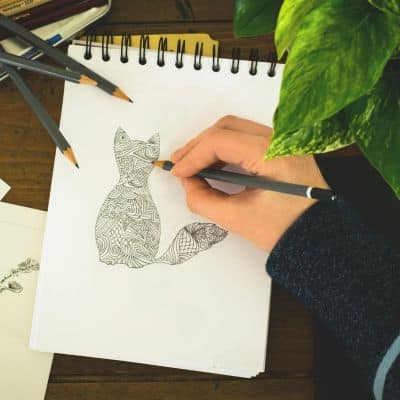
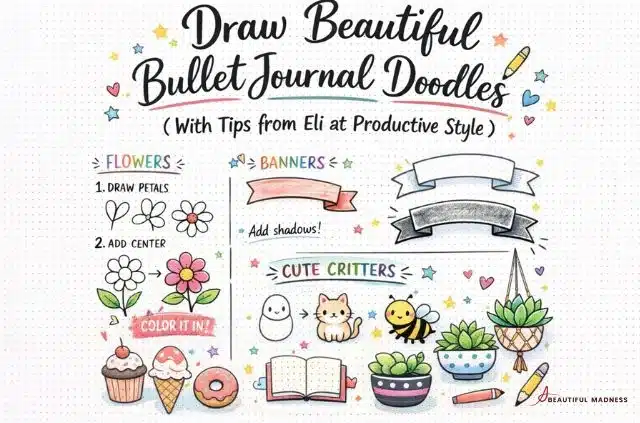
A bullet journal does not have to look like a perfectly decorated planner from Pinterest.
Sometimes the best pages are the ones with crooked stars, tiny flowers in the margins, random faces, little clouds, arrows pointing nowhere, and a coffee cup squeezed into whatever space is left.
That is where bullet journal doodle ideas come in.
You do not need to be an artist to decorate a bullet journal. A doodle can be as simple as a few lines, a tiny flower, a smiling moon, or a repeated pattern around a heading. The goal is not to create a masterpiece. It is to make your journal feel a little more like yours.
And if you have ever wondered what is a doodle drawing, why people doodle, or how to start drawing your own doodles, you are already in the right place.
This guide moves from simple beginner doodles to creative bullet journal ideas, drawing techniques, and the surprisingly interesting reason people doodle in the first place.
What Is a Doodle Drawing?
A doodle is a simple drawing made without necessarily planning a complete piece of artwork.
You might draw a row of hearts while thinking about something else, cover the corner of a notebook with spirals, or turn a few random lines into a tiny character.
That is doodling.
A doodle drawing can be realistic, abstract, decorative, funny, messy, detailed, or unbelievably simple. There are really no strict rules.
Why Are Doodles Perfect for Bullet Journals?
Bullet journals are already built around small spaces: boxes, lists, headings, calendars, trackers, notes, and margins.
Doodles fit into those spaces naturally.
A tiny flower can fill an empty corner. A line of stars can separate two sections. A little cloud can sit beside a weather tracker. Even a simple squiggle can make a plain page feel less rigid.
The beauty is that your doodles do not have to be perfect.
Actually, perfection can take some of the fun out of them.
A slightly wonky mushroom can look more charming than one drawn with a ruler.
Simple Bullet Journal Doodle Ideas for Beginners
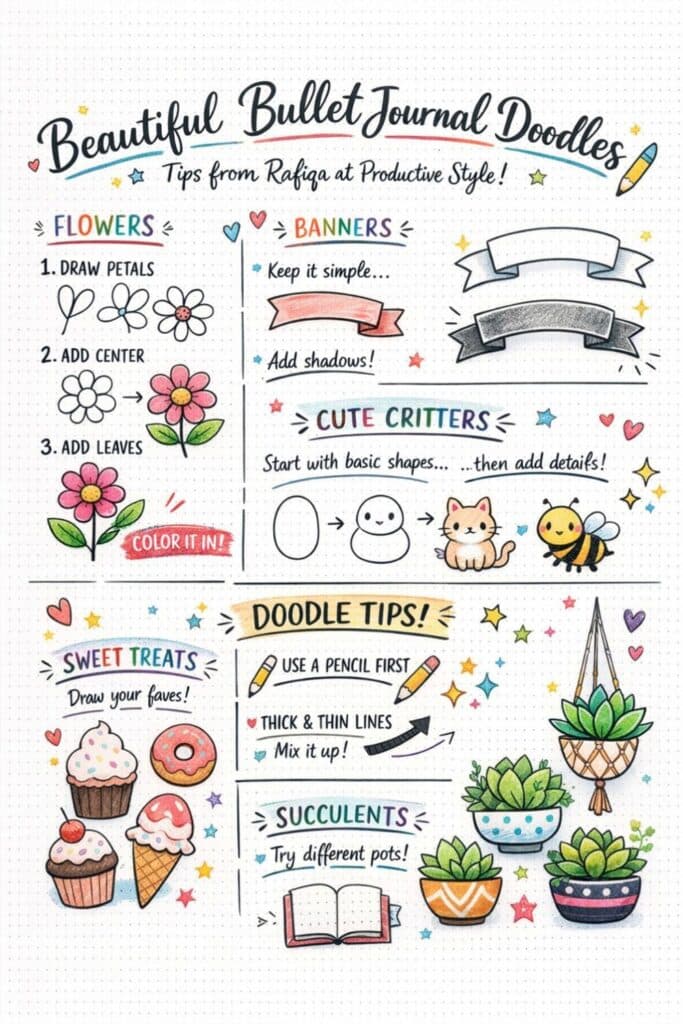
If you are holding a pen and thinking, “Okay, but what am I supposed to draw?”, start with familiar shapes.
Try:
- Tiny stars
- Hearts
- Clouds
- Sun faces
- Crescent moons
- Smiling flowers
- Leaves
- Simple butterflies
- Rainbows
- Mushrooms
- Coffee cups
- Envelopes
- Little books
- Pencils
- Candles
- Balloons
- Bows
- Simple houses
- Mountains
- Waves
- Arrows
- Stars inside circles
- Tiny planets
- Music notes
- Happy faces
- Sleeping faces
You can also turn ordinary objects into doodles.
Draw your favourite mug. Sketch your headphones. Make a tiny version of your desk. Draw the plant sitting beside your window.
The object does not have to look realistic.
It just needs to be recognisable enough for you.
Easy Bullet Journal Doodle Ideas to Try
Once you become comfortable with basic shapes, you can start combining them.
This is where doodling becomes much more interesting.
Instead of drawing one flower, for example, you can create a little flower border. Instead of drawing one star, you can scatter different-sized stars around a heading.
1. Tiny Flower Doodles
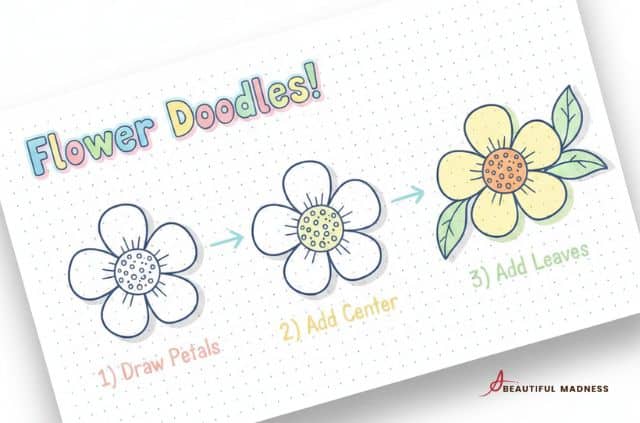
Flowers are one of the easiest things to add to a bullet journal because they work almost anywhere.
Try drawing:
- Five-petal flowers
- Tiny daisies
- Simple tulips
- Sunflowers
- Wildflowers
- Flower faces
- Flowers inside pots
- Flower borders
- Falling petals
- Flower wreaths
You can keep them as simple outlines or add a few curved lines for detail.
For more inspiration, explore these easy flower doodles and adapt the shapes to your journal style.
2. Plant and Leaf Doodles
Leaves are especially useful when you want to decorate a page without making it look too crowded.
A curved stem with three or four leaves can fill an awkward empty space in seconds.
Try:
- Eucalyptus branches
- Monstera leaves
- Simple vines
- Tiny potted plants
- Hanging plants
- Leaf borders
- Fern-like leaves
- Cactus doodles
- Succulents
- Little plant shelves
You can even use leaves around your monthly title instead of a traditional border.
3. Weather Doodles
Weather trackers give you a perfect excuse to draw tiny illustrations.
Create symbols for:
- Sunny days
- Rainy days
- Storms
- Snow
- Wind
- Clouds
- Rainbows
- Fog
- Hot weather
- Cold weather
A tiny sun with a sleepy face can make a basic habit or weather tracker feel much more personal.
4. Food and Drink Doodles

Food doodles are fun because most of them can be created from simple shapes.
Try drawing:
- Coffee mugs
- Tea cups
- Donuts
- Cupcakes
- Pizza slices
- Ice cream
- Strawberries
- Watermelons
- Apples
- Cookies
- Toast
- Pancakes
- Bowls of noodles
- Tiny sandwiches
A coffee cup beside a Monday heading?
Honestly, it almost explains the whole week.
5. Cute Animal Doodles
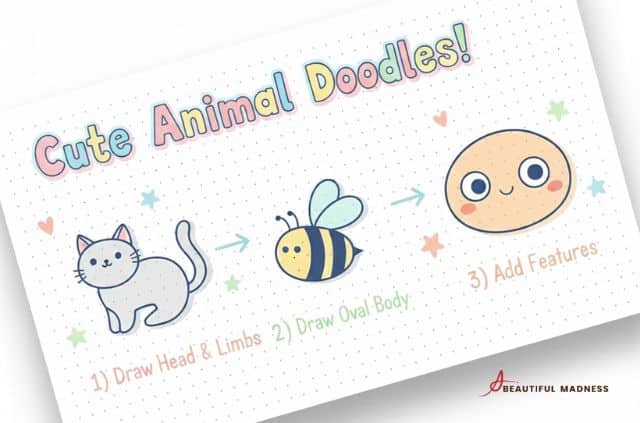
You do not need to know animal anatomy to draw cute animals.
Start with circles, ovals, ears, dots, and simple lines.
Try:
A bunny can be nothing more than a round head, two ears, two dots for eyes, and a tiny nose.
That is the point.
6. Celestial Doodles
Moon-and-star drawings work beautifully around nighttime routines, sleep trackers, journal covers, and monthly spreads.
Draw:
- Crescent moons
- Full moons
- Stars
- Shooting stars
- Planets
- Saturn
- Tiny constellations
- Clouds around moons
- Sleeping moons
- Stars with faces
You can connect several stars with thin lines to create your own little constellation.
7. Pattern Doodles
Patterns are useful when you do not know what else to draw.
Fill a box with:
- Spirals
- Dots
- Waves
- Checkerboards
- Loops
- Leaves
- Tiny hearts
- Stars
- Geometric shapes
- Repeating flowers
- Curved lines
If you enjoy repetitive patterns, you may also like exploring Zen doodle patterns.
Patterns can become especially satisfying when you repeat the same shape across an entire page.
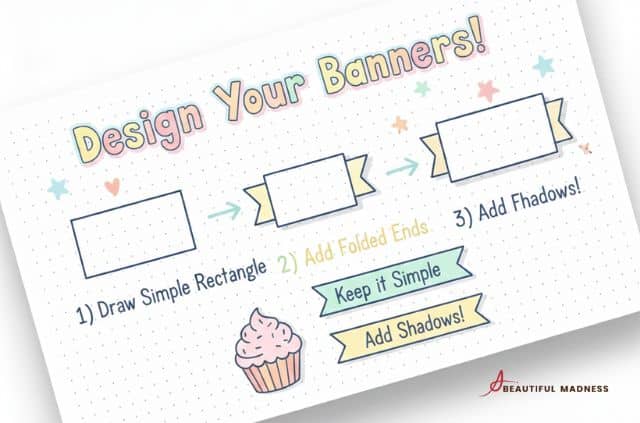
8. Banner and Header Doodles for Bullet Journals
9. Self-Care and Mindfulness Doodles
Your bullet journal can also become a quiet creative space.
Draw little symbols for things that help you slow down:
- Tea
- Candles
- Books
- Plants
- Clouds
- Breathing symbols
- Flowers
- Peaceful faces
- Sunrises
- Gentle waves
- Hands holding a cup
- A person sitting under a tree
This type of drawing can overlap nicely with mindful doodling, where the focus is less on creating impressive artwork and more on paying attention to the act of drawing.
How to Draw Doodling Step by Step
The good news is that there is no special artistic trick you have to unlock before you can doodle.
You can start with a pen and a piece of paper.
For your bullet journal, try this simple approach.
Step 1: Start With Basic Shapes
Almost everything can be broken down into simple shapes.
A flower can begin with a circle.
A cat can begin with an oval.
A coffee cup can begin with a rectangle and a curved handle.
A cloud can be several connected curves.
Do not worry about making the shape perfect.
Step 2: Add a Few Details
Once you have the basic outline, add only two or three details.
For example, a simple cat could have:
- Two ears
- Two eyes
- A nose
- Whiskers
That’s enough.
Adding twenty tiny details does not automatically make a doodle better.
Step 3: Give It a Personality
This is one of the easiest ways to make simple doodles feel original.
Give your moon sleepy eyes.
Put a tiny smile on your flower.
Add a face to your coffee cup.
Draw a little cat hiding behind a plant.
Suddenly, you are not just drawing objects. You are creating tiny characters.
Step 4: Repeat the Shape
Repetition is a doodler’s best friend.
Draw one small leaf.
Then another.
Then another.
Soon you have a leafy border.
The same idea works with stars, hearts, flowers, dots, waves, and geometric shapes.
Step 5: Add Simple Shading
You do not need complicated shading techniques.
Try:
- Small dots
- Short parallel lines
- Cross-hatching
- Darkening one side
- Filling tiny sections black
- Adding a shadow underneath an object
Even a little shading can make a flat doodle feel more finished.
Step 6: Mix Thin and Thick Lines
If you are using a pen with different nib sizes, outline the main shape with a slightly heavier line and keep the internal details lighter.
If you only have one pen, you can still create variation by going over selected sections twice.
Just don’t overdo it.
Step 7: Turn Mistakes Into Part of the Drawing
This is one of the best doodling rules.
If a line goes wrong, don’t immediately throw the page away.
Turn it into a leaf.
Make it part of a cloud.
Add another line beside it.
Transform the mistake into a pattern.
Doodling becomes much more enjoyable when you stop treating every imperfect line like a disaster.
Why Do People Doodle?
Have you ever looked down at your notebook and realised you’ve been drawing tiny stars, boxes, spirals, or random faces without consciously deciding to?
You’re not alone.
People doodle while talking on the phone, sitting in meetings, listening to lectures, waiting, thinking, or simply trying to keep their hands busy. Students, in particular, may find themselves drawing little shapes during a slow lecture or when they start feeling bored in class. Simple doodles to draw when bored in class can turn those empty corners of a notebook into something surprisingly creative.
But why do people doodle?
There isn’t one universal answer.
Sometimes it is simply boredom.
Sometimes it is habit.
Sometimes a person enjoys drawing.
And sometimes the repetitive movement of making marks on paper may help them stay engaged with what is happening around them.
Research by psychologist Jackie Andrade found that simple doodling during a monotonous listening task could help participants remember information better than doing nothing. The finding is interesting, but it doesn’t mean that every kind of doodling automatically improves concentration.
There is also a difference between random doodling and drawing something connected to what you are learning. When doodles are used alongside notes, they can become a visual way of processing and organising information rather than simply filling empty space. That is where doodle notes can fit naturally into a notebook or bullet journal.
So that little sketch in the margin might be more than meaningless scribbling.
But it might also just be a little sketch because you felt like it.
Both are perfectly fine.
Famous Doodlers and People Who Embraced Drawing
The word “doodler” can mean different things.
Some people are famous specifically for promoting doodling, while others are famous artists whose notebooks and sketches show how naturally spontaneous drawing can fit into creative thinking.
Leonardo da Vinci is a fascinating historical example. His notebooks contain observations, diagrams, studies, inventions, and sketches alongside written notes. They were not bullet-journal doodles in the modern sense, but they show how drawing can be used to explore ideas rather than simply produce finished artwork.
Pablo Picasso also produced countless quick sketches and studies. His drawings demonstrate something important for beginners: a simple line can communicate an idea without needing to become a highly detailed painting.
Modern doodling advocates such as Sunni Brown have also helped bring attention to doodling as a creative activity rather than treating it as pointless scribbling.
And then there are millions of ordinary doodlers who never become famous at all.
The student drawing stars during class.
The person filling the edge of a notebook during a phone call.
The parent drawing little animals while waiting for an appointment.
The person who automatically covers every spare corner of their planner with flowers.
They are doodlers too.
What Makes Doodling Different From Drawing?
The two overlap, but there is usually a difference in intention.
Traditional drawing often starts with an idea of what you want to create.
Doodling can begin with almost nothing.
You make a line.
Then another.
Then perhaps a circle.
Then the circle becomes a face.
The face becomes a character.
And suddenly you have a tiny creature sitting in the corner of your page.
That spontaneous process is what makes doodling so accessible.
You don’t need to know exactly where you’re going before you begin.
Bullet Journal Doodles Don’t Need to Be Perfect
This might be the most important thing to remember.
A bullet journal is not an art competition.
Your monthly spread can have uneven borders. Your flowers can have different numbers of petals. Your stars can look slightly wonky. Your little cat may accidentally look more like a potato.
That’s okay.
In fact, those little imperfections can give your journal personality.
If every line were perfectly symmetrical, the page might look polished, but it would not necessarily feel like something you made.
A Few More Bullet Journal Doodle Ideas
When you run out of ideas, combine two or three simple themes.
Try:
- A cat sleeping on a crescent moon
- Flowers growing around a calendar
- Tiny planets inside a weekly tracker
- A coffee cup surrounded by stars
- Mushrooms beneath leaves
- Bees flying around flowers
- A bookshelf filled with tiny books
- Clouds raining hearts
- A sleepy sun and moon
- A tiny house surrounded by plants
- A whale swimming through clouds
- A little bear holding flowers
- A plant growing from a coffee cup
- A rainbow inside a jar
- A bicycle covered with flowers
- A cat hiding behind a stack of books
- A moon surrounded by vines
- Tiny houses forming a border
- A garden growing around your habit tracker
- Different facial expressions in small circles
You can also browse more cool doodle ideas when you want to move beyond the usual hearts, stars, and flowers.
How to Build Your Own Bullet Journal Doodle Style
You don’t have to copy one particular doodling style.
Instead, notice what you naturally enjoy drawing.
Maybe you keep drawing plants.
Maybe every page ends up covered in tiny faces.
Maybe you love geometric patterns.
Maybe you prefer cute animals.
Maybe you like completely abstract lines.
Pay attention to those repetitions.
They are clues to your style.
For example, someone who enjoys flowers, leaves, and vines might develop a botanical doodle style. Someone who loves geometric shapes may naturally move toward structured patterns and optical effects.
Over time, your doodles become recognisable without you deliberately trying to create a “style.”
That’s often how creative habits work.
You draw the things you enjoy drawing until your hand starts developing its own way of making them.
Final Thoughts
The best bullet journal doodle ideas are not necessarily the most complicated ones.
A tiny flower can be enough.
A row of stars can be enough.
A funny face in the corner of a page can be enough.
Doodling gives you permission to draw without worrying too much about the final result. You can use it to decorate your planner, fill empty spaces, experiment with patterns, record little moments, or simply keep your hand busy while your mind wanders.
And perhaps that is why doodling has lasted for so long.
It doesn’t demand perfection.
It just asks you to pick up a pen and make a line.
Frequently Asked Questions About Bullet Journal Doodles
What are bullet journal doodles?
Bullet journal doodles are small drawings used to decorate journal pages. They make planning more fun, creative, and visually appealing without needing advanced art skills.
Are bullet journal doodles good for beginners?
Yes, bullet journal doodles are perfect for beginners. Most doodles are made using basic shapes like circles and lines, making them easy to learn and practice.
Do I need art supplies for bullet journal doodles?
No special supplies are needed. A pencil, black pen, and a few colored markers are enough to start creating beautiful bullet journal doodles.
How can I improve my bullet journal doodles?
Practice simple doodles daily, copy designs you like, and focus on consistency instead of perfection. Over time, your doodle style will naturally improve.
What should I doodle in my bullet journal?
Popular ideas include flowers, banners, icons, cute animals, food items, and borders. Choose doodles that match your mood or journal theme.