
Have you ever met someone who did not instantly seem like the most attractive person in the room, but after ten minutes with them, they somehow became the most beautiful?
Not because their face changed.
Not because their outfit suddenly looked different.
But because something about the way they listened, smiled, helped, or made people feel stayed with you.
I remember sitting in a busy coffee shop years ago and watching a woman help an elderly man who had misplaced his cane. She did not just pick it up and hand it back. She slowed down. She spoke to him gently. She sat with him for a few minutes and laughed with him as if they were old friends.
By the time I left, I could not remember the color of her coat.
But I remembered how warm she made the whole corner of that coffee shop feel.
That is the simplest way to understand inner beauty.
It is the kind of beauty people feel before they can fully explain it. It is not about having perfect skin, perfect hair, perfect clothes, or the right angle in a photo. It is about the quiet qualities that make someone feel safe, kind, steady, honest, and deeply human.
Outer beauty may catch attention first.
Inner beauty is what people remember.
Quick Answer: What Is Inner Beauty?
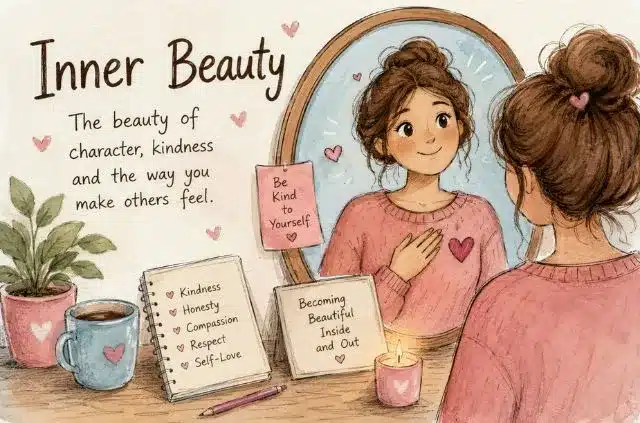
Inner beauty is the beauty of a person’s character, values, emotional warmth, kindness, confidence, honesty, and the way they treat themselves and others. It is not about physical appearance. It is about the qualities that make someone feel trustworthy, compassionate, peaceful, respectful, and good to be around. A person with inner beauty does not need to make others feel small to feel important. Their beauty shows through their actions, patience, empathy, self-respect, and quiet strength.
Inner Beauty Meaning
When people ask, what is inner beauty?, they usually do not want a greeting-card answer.
They want to know what actually makes a person beautiful beyond appearance.
Inner beauty means the qualities inside a person that shape how they think, speak, love, forgive, listen, respond, and live. It is the beauty that comes from character rather than cosmetics.
A beautiful person from the inside may still enjoy dressing well, caring for their skin, styling their hair, or feeling confident in their appearance. Inner beauty does not reject outer beauty. It simply reminds us that appearance is not the whole story.
That is why inner beauty is such an important part of becoming beautiful inside and out. One side is how you care for your body, style, energy, and presence. The other is how you care for your heart, thoughts, values, and relationships.
Both matter.
But inner beauty is the part that gives the outside meaning.
Inner Beauty vs Outer Beauty
Outer beauty is usually what people notice first.
Inner beauty is what they experience after they spend time with you.
| Outer Beauty | Inner Beauty |
|---|---|
| Appearance, style, grooming and physical features | Kindness, honesty, emotional warmth and character |
| Often noticed quickly | Often felt gradually |
| Can attract attention | Builds trust, respect and emotional connection |
| May change with age, trends or circumstances | Can deepen with self-awareness, compassion and maturity |
| Seen in the mirror | Seen in choices, words, habits and relationships |
Outer beauty can be lovely.
There is nothing wrong with wanting to look good, dress beautifully, or feel confident in your body.
But outer beauty alone does not tell people whether you are safe to trust, kind under pressure, honest when no one is watching, or gentle when someone is struggling.
Inner beauty answers those questions.
Signs of Inner Beauty
Inner beauty is not loud.
It does not always announce itself.
Most of the time, you notice it in small things.
- A person listens without rushing you.
- They do not humiliate others to feel superior.
- They take responsibility when they make a mistake.
- They give credit without needing applause.
- They are kind to people who cannot offer them anything.
- They stand up for themselves without becoming cruel.
- They make others feel seen, not small.
- They are honest without using honesty as a weapon.
- They have self-respect without arrogance.
- They try to leave people feeling better than before.
These qualities may not appear in one dramatic moment.
They usually show themselves in everyday life.
While everyone expresses kindness and empathy differently, our personality traits often shape how these qualities appear in everyday life.
How someone treats a waiter. How they speak about people who are not in the room. How they react when plans change. How they handle disappointment. How they apologize. How they behave when they are tired, stressed, or not getting their way.
That is where inner beauty becomes visible.
Real-Life Examples of Inner Beauty
Inner beauty is easy to talk about, but much easier to understand when you see it in action.
It is visible when a friend listens to you for a long time without checking their phone.
It shows when a coworker stays respectful during a high-pressure moment instead of using stress as an excuse to be harsh.
It appears when someone admits they were wrong without turning the apology into a speech about their own pain.
It is there when a person quietly helps without posting the whole act for attention.
It is present when someone encourages you without competing with you.
It is felt when a person makes space for your feelings without making you feel dramatic for having them.
These small moments often stay with us longer than perfect outfits or polished appearances.
Because people may admire how you look.
But they remember how you made them feel.
Why Inner Beauty Matters
Inner beauty matters because life is not lived in photographs.
It is lived in conversations, choices, relationships, disappointments, ordinary mornings, stressful afternoons, and quiet moments when nobody is watching.
A beautiful face can attract someone.
A beautiful heart can make them feel safe.
A stylish outfit can make a first impression.
A kind character can build a lasting one.
This is especially important in a world where so much attention goes toward appearance. Social media can make beauty feel like something measured by filters, lighting, products, likes, angles, and comparison. But real life keeps reminding us that the most meaningful kind of beauty is much harder to edit.
It is how you speak.
How you forgive.
How you handle power.
How you treat people on your difficult days.
How you treat yourself when you fail.
That is the beauty that changes the energy of a room.
The Psychology Behind Inner Beauty
Inner beauty may sound poetic, but it is also connected to very real emotional habits.
One of them is self-compassion.
Self-compassion means treating yourself with kindness when you are suffering, failing, embarrassed, or feeling inadequate. Harvard Health explains that self-compassionate people recognize their pain and respond with kindness toward themselves, which can help reduce anxiety and related depression.
This matters because the way we speak to ourselves often affects the way we show up around others.
If your inner voice is constantly cruel, impatient, and unforgiving, that pain can leak into your relationships. You may become defensive, harsh, jealous, easily triggered, or emotionally exhausted.
But when you learn to correct yourself without destroying yourself, something softens.
You become less controlled by shame.
You make room for growth.
You become more able to offer patience to other people because you are no longer starving for it yourself.
Kindness works in a similar way. Harvard Health has also discussed research suggesting that kindness is linked with happiness, social connection, lower anxiety symptoms, and even physical health markers like blood pressure.
That does not mean kindness is a magic cure for every problem.
It simply means kindness is not a weak or decorative quality.
It is one of the habits that helps people feel connected, supported, and emotionally safer around each other.
Inner Beauty Starts With Self-Talk
One of the first places inner beauty begins is the way you talk to yourself.
Not fake compliments.
Not pretending everything is fine.
Not forcing yourself to be positive every second.
Real self-kindness is much more honest than that.
It sounds like:
- “I made a mistake, but I can repair it.”
- “I am disappointed, but I do not have to hate myself.”
- “I can improve without calling myself worthless.”
- “I am allowed to rest.”
- “This is hard, but I can take the next small step.”
This kind of self-talk builds emotional steadiness.
And emotional steadiness is one of the quietest forms of beauty.
It helps you avoid turning every small problem into a storm. It helps you pause before reacting. It helps you be honest without becoming cruel. It helps you apologize without collapsing into shame.
A person who is gentle with themselves in a healthy way often becomes safer and softer with others too.
Inner Beauty and Kindness
Kindness is one of the clearest signs of inner beauty.
But real kindness is not people-pleasing.
It is not saying yes when your whole body is begging you to say no.
It is not shrinking yourself so everyone else can stay comfortable.
Real kindness has both warmth and boundaries.
It means you can care about people without abandoning yourself. You can be generous without needing to be used. You can be soft without being weak. You can speak truth without trying to wound.
That is the difference between being “nice” and being deeply kind.
Niceness often wants approval.
Kindness comes from character.
Benefits of Inner Beauty
Inner beauty changes more than the way others see you.
It changes the way you live inside your own life.
It builds deeper relationships.
People may be drawn to appearance, but they stay close to warmth, honesty, emotional safety, and respect. Inner beauty helps you become the kind of person people can relax around.
It strengthens self-respect.
When your worth is not completely dependent on attention, approval, or comparison, you become less desperate to be chosen by everyone. You begin choosing yourself with more care.
It makes confidence feel calmer.
Inner beauty creates a confidence that does not need to dominate the room. It is steady, not loud. It is secure, not superior.
It helps you handle mistakes better.
A person with inner beauty can admit fault without turning defensive immediately. They understand that accountability is not humiliation. It is growth.
It changes your presence.
When you carry less bitterness, less comparison, and less inner cruelty, people can often feel it. Your face, posture, tone, and energy may become softer because you are not constantly fighting yourself inside.
Can Inner Beauty Make You Look More Beautiful?
In a way, yes.
Not because kindness changes your bone structure or self-compassion magically gives you perfect skin.
But the way you feel inside can influence the way you carry yourself.
Stress, exhaustion, bitterness, insecurity, and constant self-criticism can show in your posture, facial expression, energy, and the way you interact with people. On the other hand, warmth, confidence, rest, self-respect, and emotional steadiness can make your presence feel more open and attractive.
This is why inner beauty and outer beauty are not enemies.
They can support each other.
Taking care of your appearance can be an act of self-respect and so can maintaining a healthy lifestyle.
Taking care of your inner world can make that beauty feel more alive.
How to Develop Inner Beauty
Inner beauty is not something you either have or do not have.
It is something you practice.
Quietly.
Imperfectly.
Often in moments nobody else sees.
1. Notice how you speak to yourself.
Pay attention to your inner voice after mistakes, rejection, embarrassment, or disappointment. If it sounds cruel, try replacing it with something honest but kinder.
Instead of “I ruin everything,” try “I did not handle that well, but I can learn from it.”
2. Practice listening without preparing your reply.
Many people listen only long enough to respond.
Inner beauty grows when you listen to understand. Let people finish. Notice their tone. Ask gentle questions. Put the phone down when someone is sharing something important.
3. Keep your promises quietly.
You do not have to announce every good thing you do.
There is something beautiful about being dependable without needing a spotlight for it.
4. Learn to apologize without excuses.
A real apology does not need a long defense attached to it.
Try saying, “I understand why that hurt you. I am sorry. I will do better.”
That kind of maturity is deeply beautiful.
5. Build small moments of mindfulness.
Mindfulness does not have to be complicated. It can be one quiet minute before replying to a difficult message. It can be breathing before reacting. It can be noticing your thoughts without believing every single one.
The University of Bath reported in 2024 that just 10 minutes of daily mindfulness was linked with better wellbeing, reduced depression and anxiety, and more motivation for healthier lifestyle choices in a large digital study.
Even a small pause can help you respond from your values instead of your mood.
6. Stand up for yourself without becoming unkind.
Inner beauty does not mean letting people walk over you.
It means you can hold a boundary without cruelty.
You can say no.
You can walk away.
You can protect your peace.
And you can do it without turning into someone you do not respect.
7. Let your actions match your values.
Values are easy to claim.
Inner beauty appears when your choices begin to match them.
If you value kindness, practice it when you are tired. If you value honesty, practice it when lying would be easier. If you value respect, practice it with people who cannot reward you.
What Inner Beauty Is Not
Inner beauty can be misunderstood.
So it is worth saying clearly.
Inner beauty is not being perfect.
It is not being quiet all the time.
It is not allowing people to mistreat you.
It is not smiling when you are hurt.
It is not pretending to be happy.
It is not performing kindness so people will praise you.
Inner beauty is much more grounded than that.
It is self-awareness.
It is emotional responsibility.
It is warmth with boundaries.
It is honesty with gentleness.
It is confidence without arrogance.
It is choosing to become a better person without hating the person you are today.
Inner Beauty in Relationships
Inner beauty becomes especially visible in relationships.
Not only romantic relationships, but friendships, family relationships, work relationships, and the little interactions we have with strangers.
A person with inner beauty does not only ask, “How do I look?”
They also ask:
- “How do people feel around me?”
- “Do I listen well?”
- “Do I make others feel safe to be honest?”
- “Do I respect boundaries?”
- “Do I take responsibility for my words?”
- “Do I give love in ways people can actually feel?”
That last question matters because people receive love differently. Some people feel loved through words. Some through time. Some through help, affection, gifts, or quiet consistency. Understanding different love languages can help inner beauty become more practical in everyday relationships.
A Simple Inner Beauty Check-In
If you want to understand your own inner beauty, ask yourself a few gentle questions.
- Do I treat myself with basic kindness when I fail?
- Do I make people feel heard?
- Do I admit when I am wrong?
- Do I need to put others down to feel better?
- Do I keep promises when no one is applauding?
- Do I know how to say no without guilt destroying me?
- Do I offer people the same respect I want from them?
- Do I make the room feel lighter or heavier?
These questions are not meant to shame you.
They are meant to bring you back to yourself.
Because inner beauty is not about never struggling.
It is about noticing where you can grow.
Frequently Asked Questions
Inner beauty is the beauty of a person’s character. It includes kindness, honesty, emotional warmth, self-respect, confidence, compassion, patience, and the way someone treats themselves and others.
Inner beauty is the beauty of a person’s character. It includes kindness, honesty, emotional warmth, self-respect, confidence, compassion, patience, and the way someone treats themselves and others.
A person is beautiful on the inside when they are kind, respectful, honest, emotionally aware, responsible, and able to make others feel valued without needing to prove they are superior.
Inner beauty and outer beauty both matter in different ways. Outer beauty can create a first impression, but inner beauty builds trust, emotional connection, respect, and lasting admiration.
Yes. Inner beauty can be developed through self-awareness, self-compassion, kindness, honest communication, emotional responsibility, mindfulness, boundaries, and consistent small actions.
Examples of inner beauty include listening patiently, apologizing sincerely, helping without seeking praise, staying respectful under pressure, keeping promises, encouraging others, and treating people with dignity.
You may have inner beauty if people feel safe, respected, heard, and encouraged around you. It also shows in how you treat yourself, how you respond to mistakes, and how you behave when nobody is watching.
Yes. Inner beauty can deeply affect relationships because qualities like kindness, honesty, patience, empathy, and emotional steadiness help people feel safer and more connected.
Final Thoughts
Inner beauty is not about becoming flawless.
It is about becoming real, kind, steady, and self-aware.
It is the way you speak when you are frustrated.
The way you listen when someone needs you.
The way you repair what you damage.
The way you treat yourself when you are not proud of yourself.
The way you make others feel after they have spent time with you.
Outer beauty may be noticed first, but inner beauty is what gives your presence depth.
It is what makes someone remember your warmth long after they have forgotten what you were wearing.
So if you are trying to become more beautiful, do not only look in the mirror.
Look at your habits.
Your words.
Your reactions.
Your values.
Your kindness.
That is where the deeper beauty begins.
And when that beauty grows inside you, it has a quiet way of touching everything around you.
