I had always been in the habit of doodling small pictures in the margins of my books and notes to assist me in remembering what I was studying. I had no clue that was a form of doodle notes.
It wasn’t overly complex at the time, but having made a great number of doodle notes over the years, I have learned my own best practices for making effective doodle notes.
So, like, research totally shows that mixing text with drawings in your notes can seriously boost your retention scores! How cool is that? Doodle notes are totally the way to go! They help you understand, remember, and recall info way better. Trust me, you’ll love it!
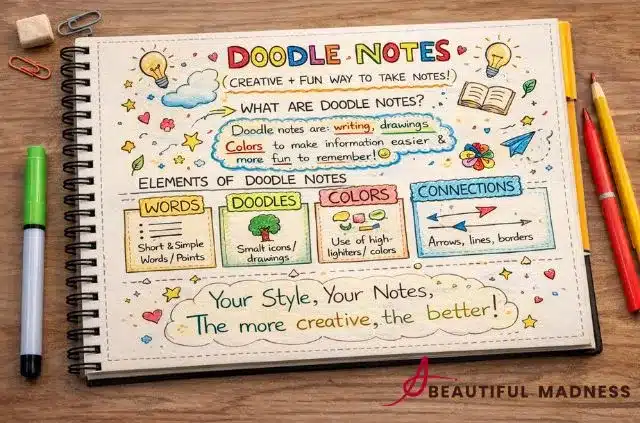
What Doodle Notes Actually Are (And Why They Work Differently)
Traditional text-based note-taking is dull and ineffective. Doodle notes are one-page notes with text, colors, drawings, and shapes.
Allow me to demonstrate its functionality. For example, if you are studying the chapter on the structure of the human cell and wish to recall that mitochondria are the cell’s powerhouse, you may draw a small battery charge adjacent to the term.
When you sketch a concept while listening to a teacher explain it, you retain it better. This is what separates doodle notes from standard note-taking styles. The act of drawing and coloring makes the lecture memorable.
Why Use Doodle Notes? I’d Say, Why Not?
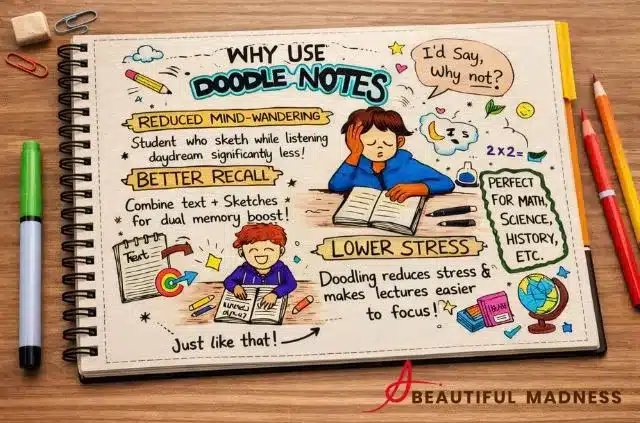
Without going into the heavy technical discussion, let’s explore the top 3 reasons for using doodle notes.
Reduced mind-wandering: Students who sketch while listening daydream significantly less than passive listeners.
Better recall of information: When you combine text and sketches, you have two ways to get the same information.
Lower stress: Doodling activity reduces cortisol levels (because it is a fun process anyway), which makes it easier to focus during lectures.
For subjects like math, science, and history, where concepts build on each other, this method is especially effective. That’s why I always say that there is no harm in at least giving it a try.
5 Ways to Use Doodle Notes Effectively (I’ve Tried Them All)
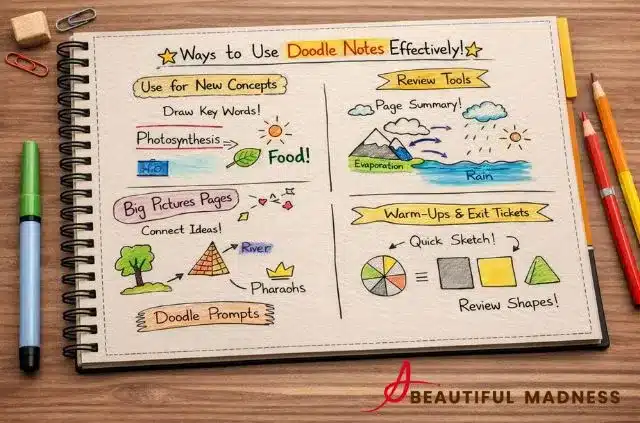
Use Them for New Concepts
What to do: Introduce key terms with visual anchors.
How to do: Instead of just writing definitions, draw a small, silly image next to each word that connects to its meaning.
A Quick Example: For “photosynthesis,” don’t just write the definition. Draw a leaf with a sun above it and a little “food” arrow going into the plant.
Use Them as Review Tools
What to do: Students create a one-page doodle note summary of a full chapter or unit
How to do it: Assign a layout and let students choose what to sketch
A Quick Example: A student maps the water cycle using arrows, icons, and short labels. This also works brilliantly as one of those art activities for kids that doubles as a learning material.
Create “big picture” Summary Pages
What to do: Use one page to connect multiple related ideas.
Instructions: Begin by illustrating a central image or subject in the center of the page. Subsequently, branch out with additional images, keywords, and arrows that connect related subtopics.
A Quick Example: For ancient Egypt, put a pyramid in the center. Branch out to “Nile River” with a wavy line and “pharaohs” with a crown.
Use Them as Warm-Ups or Exit Tickets
What to do: Give students 3 to 5 minutes to do a quick doodle sketch of the previous lesson.
How to do it: There should be a blank box with a suggestion like “draw what you remember about…”
A Quick Example: Before starting a new geometry topic, students sketch and label the shapes they already know.
Leave Room for “Doodle Prompts”
What to do: Give students small, specific drawing tasks during the lesson to keep them engaged.
How to do: Pause every few minutes and say, “Draw a quick sketch of…” or “Add a symbol that represents…”
A Quick Example: While teaching fractions, say: “Pause. Draw a pizza cut into 4 slices, then shade 3 slices.” Now students have a visual reference for ¾, and their hands stayed busy while you explained the concept.
How to Create Doodle Notes from a Blank Page (Complete DIY Guide)
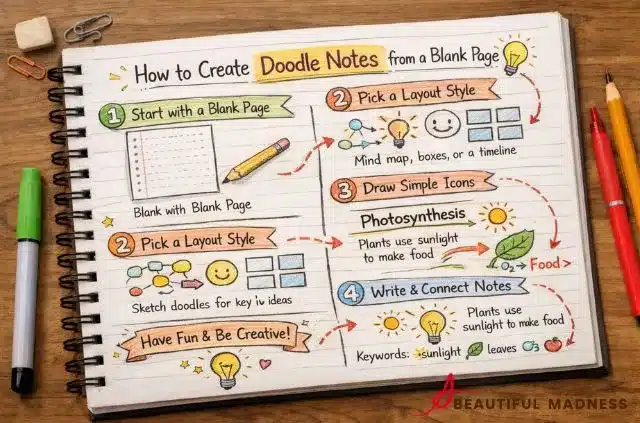
Creating your own doodle notes takes about 20 to 30 minutes once you know the structure. Once doodling becomes a second nature to you, it will take you even less time to create an impressive doodle notes structure.
Step 1: Start from a Blank Page

The blank page is the hardest part. But I’ve cracked the code.
Gather your tools: Papers and pens, mainly. Maybe colors, if you want to make it fancy. But I’d suggest keeping things simple.
Container structure: Sketch the containers (such as rectangles, organic lumps, and lines) that will contain your content. The page is rendered less intimidating by dividing the vacant space.
Step 2: Follow Some Kind of Layout
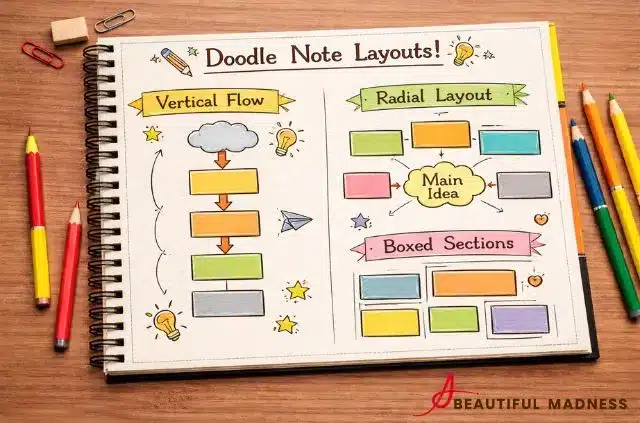
There are some interesting ways to go about it.
The Vertical Flow: Best for linear processes or timelines. Information moves top to bottom on this layout.
The Radial Technique: Write the main idea in the center and branch out the subtopics. You might have heard this technique referred to as mind mapping as well.
Boxed Sections Layout: Divide the page into different sections and give each idea its own box.
Step 3: Sketching
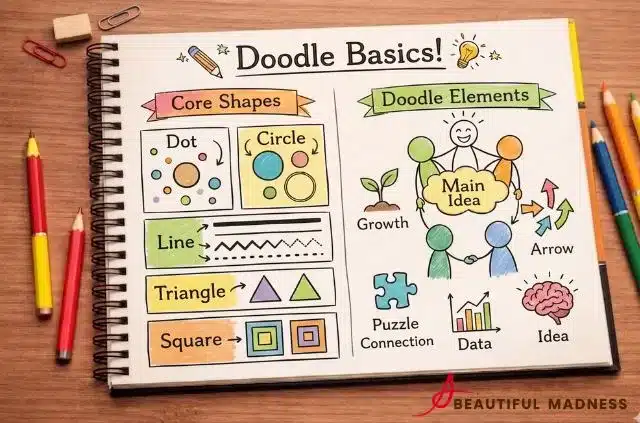
Now comes the main step. And believe me, you can draw doodle notes well even if you are not an artist. Just follow the following tips:
Master the “5 Basic Elements”: Everything is a combination of these: Dot, Circle, Line, Triangle, Square.
Use Stick Figures and Faces: To represent people, emotions, or actions.
Use the “Icon Library” Method: Don’t draw what you see; draw what represents the concept. Create a library of interesting doodle icons.
- Growth: Upward arrow, plant sprout, staircase.
- Connection: Chain links, puzzle pieces, handshake.
- Idea: Lightbulb, exclamation mark, brain.
- Data: Pie chart, bar graph, document.
- Action: Lightning bolt, gear, running figure.
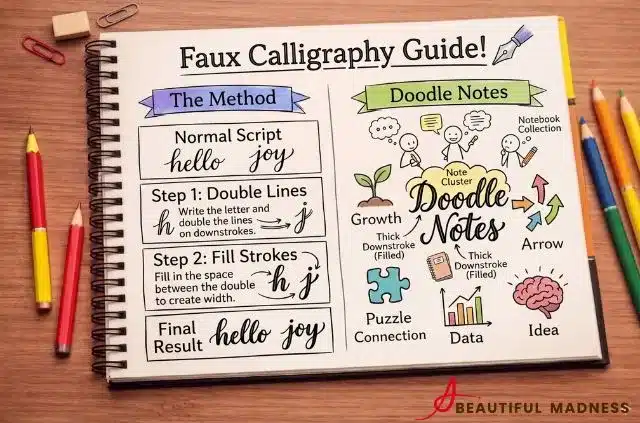
Try “Faux Calligraphy”: To make titles pop without a brush pen. Write the word in cursive or block letters. Draw a second line next to every downward stroke. Then, fill in the space between the two lines.
Step 4: Write the Notes
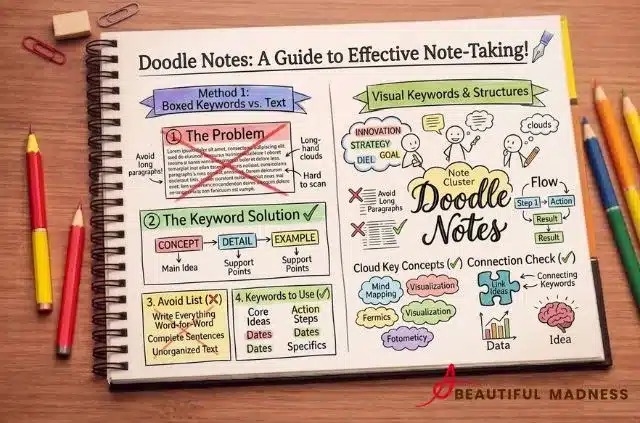
Now you have a kind of skeleton for doodle notes. The next step is actually to write the stuff you want to learn and remember.
Don’t focus on everything: Just focus on the main definitions and important concepts. You can’t write each phrase anyway.
Write in keywords: Add short phrases in visual containers. Avoid writing full sentences.
Fill in Color with Purpose: Don’t color randomly. Assign roles to colors.
What Is the Best Layout for Doodle Notes? Ideas for Different Subjects
Formula Flow
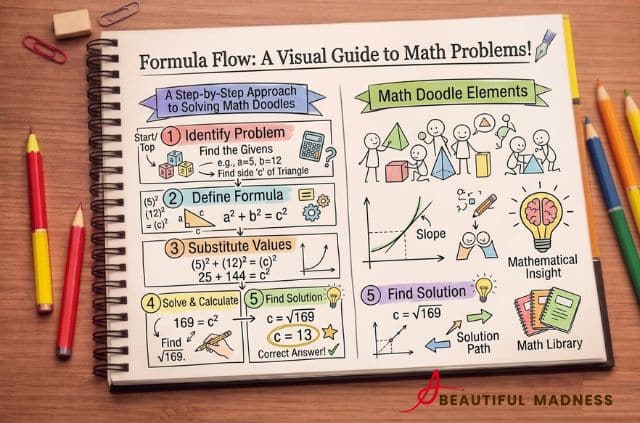
Best for: Algebra and Geometry
Focus: Step‑by‑step processes and formulas
Use Icons: Calculator, graph curve, equal sign, and lightbulb for tips.
A vertical column of numbered boxes works best for math procedures. Each box holds one step, a short formula, and a small sketch showing what that step looks like with real numbers.
Lab & Process
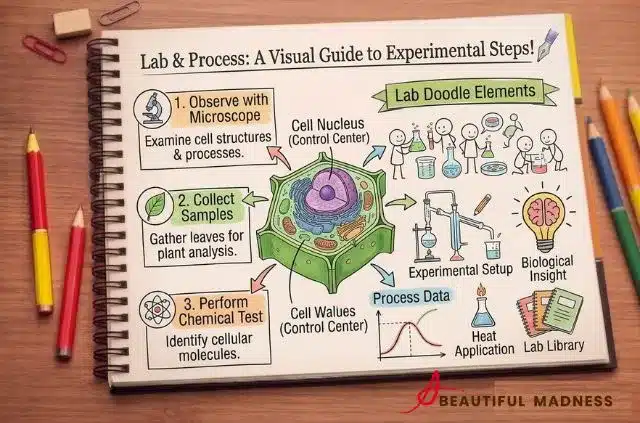
Best for: Biology, Chemistry, Physics (experiments, cycles, anatomy)
Focus: Diagrams, sequences, cause-and-effect.
Icons: Microscope, leaf, atom, beaker, and flame.
Place a central illustration (a cell, a circuit, a landform) in the middle of the page. Radiate labeled arrows outward to boxes explaining each component.
Timeline & Cause/Effect
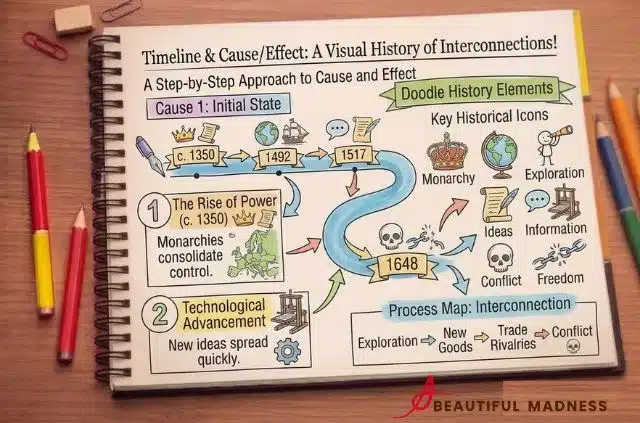
Best for: Events, biographies, cause/consequence
Focus: Chronology, geography, connections.
Icons: Scroll, crown, globe, speech bubble for quotes, skull for consequences.
A horizontal or diagonal timeline works well for event sequences. Each point on the line gets a date, a one-line description, and a small icon sketch.
How to Do Hand-Drawn Doodle Notes (Beginner-Friendly Techniques)
- Start with Simple Shapes, Not Details
Everything in doodle notes can be built from rectangles, circles, triangles, and lines.
- A person is a circle for a head and a rectangle for a body.
- A flower can be a circle with petals.
- A house is a square with a triangle.
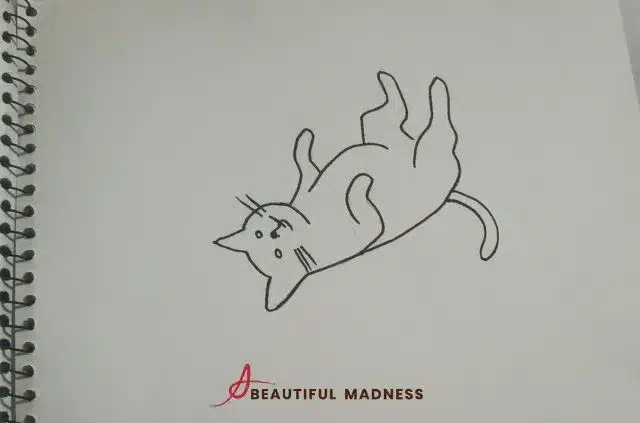
Also You can draw cute cat doodle
- Create Boxes, Arrows, and Section Dividers
Boxes and borders add structure to a page even without artistic talent:
- Double-line borders make headings stand out
- Dashed borders visually separate optional or supplementary info
- Bold arrows guide the eye between connected ideas
- Starburst or cloud borders highlight definitions or key takeaways
- Use Bubble Letters
Bubble letters are just regular letters with an outline drawn around them. Write the word in pencil first, then trace around each letter. Leave a small gap from the original strokes.
Digital vs. Paper Doodle Notes: Which One Works Better?
Some of you might still find the hand-drawn doodle a hassle. So you can experiment with digital tools as well. However, there would be a difference in outcome.
| Factor | Paper Notes | Digital Notes |
| Memory retention | Higher (handwriting activates more neural pathways) | Moderate |
| Flexibility | Limited to what you print or draw | Easily edited and reshared |
| Engagement | Tactile; coloring adds a kinesthetic benefit | Depends on stylus use |
For most students, paper-based doodle notes produce stronger retention because the physical act of handwriting and coloring engages more of the brain than tapping on a screen. I personally love handwritten notes more. But, that being said, there are some benefits of digital notes you can’t ignore.
Digital doodle notes are more practical for remote learners. Tools like Notability and GoodNotes allow students to sketch on a tablet using a stylus, which preserves most of the handwriting benefits.
Ready to Draw Doodle Notes? Here is My Final Advice
Whether you go digital or paper, the key is to keep practicing. And if you ever want to sharpen your hand at sketching, there are several beginner-friendly drawing ideas to explore. This is how I learnt to make rich doodle notes, and you can do the same.